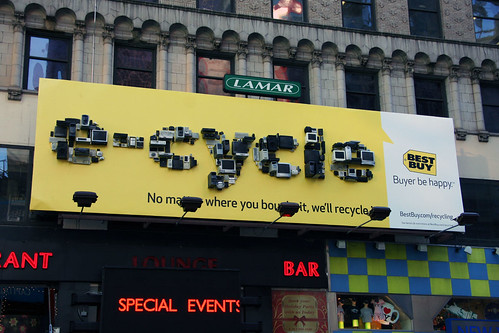
Activity - Investigate the options and end fate of your household’s e-waste. Discuss where and how you will dispose of this waste and your future electronics purchase plans in relation to the waste they will one day become.
Many electronic device contain unknown amounts of ridiculously dangerous chemicals, all to make our lives easier, but whose complains, only mother nature. Finding a proper disposal site for electronics is becoming an easier task than it used to be. Many large electronic stores now take back what you bought from them as E-waste. This is a responsible action, by keeping dangerous amounts of toxins out of landfill but what happens to waste products. Two things, one good, one bad. The good is the E-waste is taken to a responsible recycler who uses the proper safety equipment and containment to prevent any contamination to people or the environment. Although a good choice, this process is extremely expensive. This leads to option two, the bad. Some E-waste, or very large amounts, is shipped back to china, here the waste is dispersed from the port in large trucks to very poor villages. Since jobs are a very rare commodity, people will work in more dangerous environments to get paid. The poor are taken advantage of to disassemble and pick apart computers, TV’s, and other electrical components for the valuable metals within. The problem is the workers are unprotected, very underpaid, and it impacts the environment through contamination. E-waste is a very hard product to reuse, and the intense combination of many materials, almost makes it impossible to separate.
E-waste generate at my household ends up back at the electronic store, that has approved techniques for disassembly. I found though that a lot of people have a hard time throwing away electronics, as the initial cost was so much, and they end up sitting in the back of the closet for years, until rediscovered as antiques, like Nintendo. I guess that could be option three for recycling, the option of reusing or rediscovering happiness.
Many large producers of electronics are taking note of what consumers are looking for in new items, and are creating TV’s and computers that have less toxins. One of the most recent selling items I experienced was a mercury free flat screen TV’s, even with auto dim when no one is watching to conserve energy. The market is going in the right direction, and manufactures are pushing this way because it is easier to reuse metals that are already mined and processed, than having to always mine for new minerals. In the end going greener should make the market place a more affordable place to spend hard earned money.
For more information follow the link to RCT a recycling company
Wednesday, April 7, 2010

Blog 6 - - - Reflections - Sludge
Where does your sludge go? Does this surprise you?
The entire concept of waste removal is more or less a hidden operation, just a whole in the ground, there one second gone the other. Watching the waste management movies in class really make everyone realize the large scale operation that needs to take place for society to exist. The sewer system is probably the number one system that is over looked for continence. Based just north of the city of Winnipeg, but still have a connecting to the city grid for waste removal. The waste produced from my area is routed to the Winnipeg north end plant for treatment. To the general public this seems like a good controlled operation and nothing to worry about, other than a slight smell. The truth is that the dual share system, in older Winnipeg isn’t the ideal solution for waste management. Since water and waste water share the same pipes, the treatment plant can become overloaded and forces to dump, unprocessed sewage, directly into the river. While doing this article, I was informed that the rapid melting and increasing flood waters has put enough strain on the system to cause it to purge untreated material for 5 hours this past weekend. Know the impacts of these actions can surprise people initially, but then brush it off as “there enough water in the river to dilute it”, but reality is that the nitrates and phosphors’ are going to have a much large impact downstream. The rate of nitrification taking place in lake Winnipeg is direct proof of the impact of releasing untreated water into the water ways flowing through the city. The lake is becoming a dead zone, impacting the community and the local economy. These large changes happen very quickly, but reversing these effects takes a very long time, up to 40 years with a natural marsh system. People have to be more responsible when dealing with nitrate charged materials, like in lawn care, and the city has to find a better way of dealing with the sewage problem. A year release rate of 15 time is way too high, to decrease the nitrification in lake Winnipeg. The city will have to come together as a whole to find better ways to cut down on water use, and a more efficient way of eliminating bio wastes.
The entire concept of waste removal is more or less a hidden operation, just a whole in the ground, there one second gone the other. Watching the waste management movies in class really make everyone realize the large scale operation that needs to take place for society to exist. The sewer system is probably the number one system that is over looked for continence. Based just north of the city of Winnipeg, but still have a connecting to the city grid for waste removal. The waste produced from my area is routed to the Winnipeg north end plant for treatment. To the general public this seems like a good controlled operation and nothing to worry about, other than a slight smell. The truth is that the dual share system, in older Winnipeg isn’t the ideal solution for waste management. Since water and waste water share the same pipes, the treatment plant can become overloaded and forces to dump, unprocessed sewage, directly into the river. While doing this article, I was informed that the rapid melting and increasing flood waters has put enough strain on the system to cause it to purge untreated material for 5 hours this past weekend. Know the impacts of these actions can surprise people initially, but then brush it off as “there enough water in the river to dilute it”, but reality is that the nitrates and phosphors’ are going to have a much large impact downstream. The rate of nitrification taking place in lake Winnipeg is direct proof of the impact of releasing untreated water into the water ways flowing through the city. The lake is becoming a dead zone, impacting the community and the local economy. These large changes happen very quickly, but reversing these effects takes a very long time, up to 40 years with a natural marsh system. People have to be more responsible when dealing with nitrate charged materials, like in lawn care, and the city has to find a better way of dealing with the sewage problem. A year release rate of 15 time is way too high, to decrease the nitrification in lake Winnipeg. The city will have to come together as a whole to find better ways to cut down on water use, and a more efficient way of eliminating bio wastes.
Blog 6 - - - Class Reflections - Movie - Fat Lake
The movie explains how too much of a good thing can have very large negative impacts. The troubles area caused by nitrification from too much phosphorus run off, killing the lake, by taking up all the oxygen. Humans have increased the amount of phosphorus in nature through many processes. The site of the lake collects 950,000 square kilometres of land run off, greatly increasing growth rates form the increased levels of nitrogen and phosphorus. This is leading to a much higher biomass, but it is starving the water for oxygen, as the algae takes over. Surrounding marshes are an excellent natural filter, but are now being over whelmed, and marshes are disappearing, turning into lifeless lakes themselves. The number of marshes has dropped from 10% to 0.01% in the red river basin. The blue green algae is taking over from the nitrification, and the end of season die off is starving the entire lake of oxygen, killing fish and other forms of life, overall it creates dead zone. Determining who to blame is to much of the current focus, people need to begin taking action themselves to help in the reduction of phosphorus injection points. An example could be moving cattle further away from, or limiting time near watering/river drinking sources. Water needs to be slowed down, so natural filter systems, like marshes, have a chance to absorb nutrients, and to help solve the overgrowth problem.
This movie and many more effective one like it were released at the Manitoba Eco-Network Environmental Film Festival, this was a great event for spreading the word for problems currently being faced, follow the link in the links menu for future dates.
This movie and many more effective one like it were released at the Manitoba Eco-Network Environmental Film Festival, this was a great event for spreading the word for problems currently being faced, follow the link in the links menu for future dates.
Blog 6 - - - Section 33
At the Shrine
Environmental actions have many factors to consider; using just an economic evaluation is ineffective and requires a more detailed understanding. Too often consumer approaches are taken only regarding the economical value of a situation, and only be become problem when resources located on a piece of land become redistricted, showing that current decisions are based around market value and not natural and environmental values. Land is a commodity, changing it in to a monetary value, ignoring ecological equals. Problems arise when people don’t consider themselves consumers, but view themselves as citizen. People enjoy supporting environmental actions as a community, but rarely do little on a personal level to help the cause. Many people will vote for a carbon tax, but continue to drive inefficient cars, or disapprove the use of harmful chemicals and still use phosphorous cleaning agents. Some recent changes in decision making, has instated the use of the Cost-Benefit analysis. This helps bring economic goals down from the spot light, and uses a more rounded approach to consider apparent regulations, infused with more aesthetics and morals. When determining safety compared to efficient using this kind of model, it tend to fall apart in some ways. People working in dangerous environments become part of the cost-benefit, and in doing so have a price put on there worth. When trying to improve working conditions, arguments have to be made to prove that a safer environment is worth it in the long run. This seem very unfair to the workers, as safer practices are available, but company regulations say it to expensive to make them better. This makes people expendable, and viewed only as a piece of the process. Workings around dangerous chemicals have many unknown long term effect, and not using the safest equipment seem unjust. The really focus should be how safe is the work place, if it cost to much. The cost-benefit analysis tries to improve the decision making process by adding value to equal parties. The downfall is the decision revolves around the people who are financing the decision; still making the overall decision one sided. To improve this attempt of a solution, a neutral part is required to mitigate the arguments, mostly in the form of an economist, and prevent the argument from turning into a money battle. Using this kind of modified decision making process more equal to all parties, as a detailed debate can determine, on all factors. Using this approach also disallows the market from taking charge, and using demand to strong arming a decision. The throughout solutions can provide the best, positive, safe, and aesthetic solution.
I think it is the work places responsibility to proved the safest environment as technologically possible, dependent not on money, but the chemical being used in production. Since many chemical lack long term testing, putting low values on workers is unfair when making decisions. If the cost-benefit analysis is going to be used, and long term effects of the chemicals cannot, or have not been proven yet, workers health should be priceless. Using a high value for life on the job will greatly reduce the amount of cancer causing agents exposed while processing. Applying this thinking to land decisions can be quite similar. Until the effects of a chemical can be proven, land should also be viewed as priceless. Natural environments only happen once, if there destroyed, they eventually disappear, along with their vital functions that we depend on.
Environmental actions have many factors to consider; using just an economic evaluation is ineffective and requires a more detailed understanding. Too often consumer approaches are taken only regarding the economical value of a situation, and only be become problem when resources located on a piece of land become redistricted, showing that current decisions are based around market value and not natural and environmental values. Land is a commodity, changing it in to a monetary value, ignoring ecological equals. Problems arise when people don’t consider themselves consumers, but view themselves as citizen. People enjoy supporting environmental actions as a community, but rarely do little on a personal level to help the cause. Many people will vote for a carbon tax, but continue to drive inefficient cars, or disapprove the use of harmful chemicals and still use phosphorous cleaning agents. Some recent changes in decision making, has instated the use of the Cost-Benefit analysis. This helps bring economic goals down from the spot light, and uses a more rounded approach to consider apparent regulations, infused with more aesthetics and morals. When determining safety compared to efficient using this kind of model, it tend to fall apart in some ways. People working in dangerous environments become part of the cost-benefit, and in doing so have a price put on there worth. When trying to improve working conditions, arguments have to be made to prove that a safer environment is worth it in the long run. This seem very unfair to the workers, as safer practices are available, but company regulations say it to expensive to make them better. This makes people expendable, and viewed only as a piece of the process. Workings around dangerous chemicals have many unknown long term effect, and not using the safest equipment seem unjust. The really focus should be how safe is the work place, if it cost to much. The cost-benefit analysis tries to improve the decision making process by adding value to equal parties. The downfall is the decision revolves around the people who are financing the decision; still making the overall decision one sided. To improve this attempt of a solution, a neutral part is required to mitigate the arguments, mostly in the form of an economist, and prevent the argument from turning into a money battle. Using this kind of modified decision making process more equal to all parties, as a detailed debate can determine, on all factors. Using this approach also disallows the market from taking charge, and using demand to strong arming a decision. The throughout solutions can provide the best, positive, safe, and aesthetic solution.
I think it is the work places responsibility to proved the safest environment as technologically possible, dependent not on money, but the chemical being used in production. Since many chemical lack long term testing, putting low values on workers is unfair when making decisions. If the cost-benefit analysis is going to be used, and long term effects of the chemicals cannot, or have not been proven yet, workers health should be priceless. Using a high value for life on the job will greatly reduce the amount of cancer causing agents exposed while processing. Applying this thinking to land decisions can be quite similar. Until the effects of a chemical can be proven, land should also be viewed as priceless. Natural environments only happen once, if there destroyed, they eventually disappear, along with their vital functions that we depend on.
Blog 6 - - - Section 31
Living Downstream
The use of toxic chemicals in our everyday lives might have greater impacts than originally thought. More research has to be done to identify the cause and point source of cancer causing chemicals. People have to realize that the environment plays a large role in caner causing problem, more than genetically inherited traits. Understanding the cause of cancer is one thing, but having the public awareness of the effects, symptoms, and how to check for the dieses is another. Cancer consists of a very settle change in the DNA structures, making it difficult to recognize and find solutions. In the case from the article, bladder cancer is started, or caused, from carcinogens making contact with the cell walls, most notably from aromatic amines. The use of many chemicals to do daily processes can cause major effects to the human body, some resulting in cancer. These effects are noticed usually in industrial settings, where large amounts of workers are suffering from similar problems. Aromatic amines affect vast amounts of people, from their surround environment, in small quantities. This type of carcinogen was also the first type to be discovered, due to the large effect on humans. This cancer relies on the environment to infect. For example 1/3 of this cancer is related to cigarette smoke, first or second hand. Also industrially contaminated water has be proven to be a large problem, even in trace amounts. The danger of using untested chemicals becomes apparent, as these cancers causing agents are used throughout the U.S., with little to no restriction, because until now the effects weren’t known. Current research efforts are working on finding hereditary and acquired cancer origins, and if they do have substantial impacts in increasing the chance of contracting cancer. People have the right to know about health risk, especially environmental hazard, like spring hill. Susceptible traits that are inherited tend to have a increased risk when facing a hazardous environment, greatly increasing the need of awareness. To grasp the problem with chemical pollution, one must look at the past, future, and present. The past provides information, and a understanding on how the impact today originated, and possibly the type of chemical. The present looks at human rights and the use of untested chemicals. Banning there use can prevent many unknown problems that can occur in future generations, in the same way the past is effect the present right now. This chemical contamination is a leading cause of death throughout the U.S., and solutions need to be found to prevent further pollution hazards. The use of the “principal of the least toxic alternative” ensures that the most environmentally friendly options/products will be used first before toxic alternatives are though of. Our views have to move from “how much toxic chemicals are acceptable”, to “What alternative ways are there instead”.
The use of toxic chemical is necessary in some setting, but a lot of the time are used and abused beyond their intended use. This kind of thinking takes away from the overall health of communities. Chemical need to be responsible used, as one bad choice today, may effect many generations in the future. The speed at which chemicals are being produce, so should the amount of proper disposal sites. More options and education of the options for dealing with unwanted chemical waste, will greatly reduce the illegal dumping, and corporations with government influence, to hide there expensive wastes. Providing education to dumpers, might make them realizes that harmless chemical apart might form deadly strains when combined. It is also important that testing should be done on chemical before they are released, to understand potential impacts of human and the natural environment. Safety should always be first.
The use of toxic chemicals in our everyday lives might have greater impacts than originally thought. More research has to be done to identify the cause and point source of cancer causing chemicals. People have to realize that the environment plays a large role in caner causing problem, more than genetically inherited traits. Understanding the cause of cancer is one thing, but having the public awareness of the effects, symptoms, and how to check for the dieses is another. Cancer consists of a very settle change in the DNA structures, making it difficult to recognize and find solutions. In the case from the article, bladder cancer is started, or caused, from carcinogens making contact with the cell walls, most notably from aromatic amines. The use of many chemicals to do daily processes can cause major effects to the human body, some resulting in cancer. These effects are noticed usually in industrial settings, where large amounts of workers are suffering from similar problems. Aromatic amines affect vast amounts of people, from their surround environment, in small quantities. This type of carcinogen was also the first type to be discovered, due to the large effect on humans. This cancer relies on the environment to infect. For example 1/3 of this cancer is related to cigarette smoke, first or second hand. Also industrially contaminated water has be proven to be a large problem, even in trace amounts. The danger of using untested chemicals becomes apparent, as these cancers causing agents are used throughout the U.S., with little to no restriction, because until now the effects weren’t known. Current research efforts are working on finding hereditary and acquired cancer origins, and if they do have substantial impacts in increasing the chance of contracting cancer. People have the right to know about health risk, especially environmental hazard, like spring hill. Susceptible traits that are inherited tend to have a increased risk when facing a hazardous environment, greatly increasing the need of awareness. To grasp the problem with chemical pollution, one must look at the past, future, and present. The past provides information, and a understanding on how the impact today originated, and possibly the type of chemical. The present looks at human rights and the use of untested chemicals. Banning there use can prevent many unknown problems that can occur in future generations, in the same way the past is effect the present right now. This chemical contamination is a leading cause of death throughout the U.S., and solutions need to be found to prevent further pollution hazards. The use of the “principal of the least toxic alternative” ensures that the most environmentally friendly options/products will be used first before toxic alternatives are though of. Our views have to move from “how much toxic chemicals are acceptable”, to “What alternative ways are there instead”.
The use of toxic chemical is necessary in some setting, but a lot of the time are used and abused beyond their intended use. This kind of thinking takes away from the overall health of communities. Chemical need to be responsible used, as one bad choice today, may effect many generations in the future. The speed at which chemicals are being produce, so should the amount of proper disposal sites. More options and education of the options for dealing with unwanted chemical waste, will greatly reduce the illegal dumping, and corporations with government influence, to hide there expensive wastes. Providing education to dumpers, might make them realizes that harmless chemical apart might form deadly strains when combined. It is also important that testing should be done on chemical before they are released, to understand potential impacts of human and the natural environment. Safety should always be first.
Blog 6 - - - Section 20
Impacts of biodiversity loss on ocean ecosystem services
Humans rely heavily on natural process and diversity of species to harvest abundant crops and wild life, such as wheat and fish. The human impacts on the environment are beginning to take an unknown toll on many ecosystems. Resource collapses are increasing, as recovery rates, stability, and quality are decreasing, resulting from the loss of diversity. In the marine setting, dealing with fish, has a link between biodiversity and the amount of food, fish for humans, the ocean can produce. Trying to increase diversity is very difficult, but decreasing it is very easy. The loss of diversity is a result of exploitation, pollution, and habitat destruction. Experiments have also shown the importance of diversity, not only in species, but also in food sources. The combination of both factors has shown a better rebound and resistance from harmful events. The loss of biodiversity reduces the following three functions.
•The number of viable fisheries, provisions of nursery habitats, and filtering/detoxification.
•The loss of filtering is a major contributor to the decrease of water quality.
•The loss of natural species from these effects promotes the infiltration of adverse species, simplifying the biodiversity.
Looking at larger marine environments, showed that the simplification of fish species is occurring, as 20% of fish species has already disappeared. This trend was accelerated in areas that had poor species density and food supply. Having good species diversity prove again to be beneficial, in aiding in rebuilding after a major collapse, saving local, native, and diversity. This concept is further backed up by the portfolio effect, where the large amount of fish species in the area allows fishers to switch from species to species, to prevent over fishing on a singular species, but still allowing for a large enough catch to feed a community. Resources and fishery closures are currently being reused as large scale experiments. They are being used to test the effects of regeneration of fish density and diversity. It has been proven that regeneration is possible when the proper control is placed on additive, activities, and tourism. Protecting diversity and ecosystems is an important issue locally and nationally. The loss of locally adapted populations dramatically reduces stability and recovery rates, rapidly changing the larger marine system. Investment has to be made now in pollution control, fishery limits, and habitat maintenances, to prevent, and to ensure, the economic plans are aware of the values of these systems. The loss of the function of the systems would put global food security, water quality, and economic stability at risk and pushing out problems now, on to future generations.
Understanding the importance of the fishing community, and the importance of a health water systems, put a great responsibility on the people that rely on both systems for food and drinking water. Fishing communities need to understand that overfishing will only make life harder in the coming years. Taking what is an only needed and switching type of fish during times of the year, will allow the natural ecosystems to produce more fish to be caught as a result, improving life instead. Sometimes being conservative can result in more gains than being aggressive; this though also applies to the use of land and chemicals. Finding more efficient ways to use both can also greatly reduce the impacts on fish populations and food supplies.
Humans rely heavily on natural process and diversity of species to harvest abundant crops and wild life, such as wheat and fish. The human impacts on the environment are beginning to take an unknown toll on many ecosystems. Resource collapses are increasing, as recovery rates, stability, and quality are decreasing, resulting from the loss of diversity. In the marine setting, dealing with fish, has a link between biodiversity and the amount of food, fish for humans, the ocean can produce. Trying to increase diversity is very difficult, but decreasing it is very easy. The loss of diversity is a result of exploitation, pollution, and habitat destruction. Experiments have also shown the importance of diversity, not only in species, but also in food sources. The combination of both factors has shown a better rebound and resistance from harmful events. The loss of biodiversity reduces the following three functions.
•The number of viable fisheries, provisions of nursery habitats, and filtering/detoxification.
•The loss of filtering is a major contributor to the decrease of water quality.
•The loss of natural species from these effects promotes the infiltration of adverse species, simplifying the biodiversity.
Looking at larger marine environments, showed that the simplification of fish species is occurring, as 20% of fish species has already disappeared. This trend was accelerated in areas that had poor species density and food supply. Having good species diversity prove again to be beneficial, in aiding in rebuilding after a major collapse, saving local, native, and diversity. This concept is further backed up by the portfolio effect, where the large amount of fish species in the area allows fishers to switch from species to species, to prevent over fishing on a singular species, but still allowing for a large enough catch to feed a community. Resources and fishery closures are currently being reused as large scale experiments. They are being used to test the effects of regeneration of fish density and diversity. It has been proven that regeneration is possible when the proper control is placed on additive, activities, and tourism. Protecting diversity and ecosystems is an important issue locally and nationally. The loss of locally adapted populations dramatically reduces stability and recovery rates, rapidly changing the larger marine system. Investment has to be made now in pollution control, fishery limits, and habitat maintenances, to prevent, and to ensure, the economic plans are aware of the values of these systems. The loss of the function of the systems would put global food security, water quality, and economic stability at risk and pushing out problems now, on to future generations.
Understanding the importance of the fishing community, and the importance of a health water systems, put a great responsibility on the people that rely on both systems for food and drinking water. Fishing communities need to understand that overfishing will only make life harder in the coming years. Taking what is an only needed and switching type of fish during times of the year, will allow the natural ecosystems to produce more fish to be caught as a result, improving life instead. Sometimes being conservative can result in more gains than being aggressive; this though also applies to the use of land and chemicals. Finding more efficient ways to use both can also greatly reduce the impacts on fish populations and food supplies.
Blog 6 - - - Section 10
Life and death of the salt marsh
Understanding the important factors of salt marches are critical to the conservation of water quality. Salt marshes are located on the coast of the oceans, and can grow on land and float in the ocean. They flourish in tidal zones, from being exposed to the mixture of water and air throughout the day. Marshes create many distinctive features, and they can be used to determine the health of a salt water marsh system. Sounds of bubbling air and the smell of iodine are produced as healthy marshes process and grow, where as polluted marshes change, sounds are reduced and rotten eggs replace the natural smell of the ocean. Healthy marshes also have a correct feeling, the feeling of the ground is squishy, as people walk on it, this shows a good mixture of root, mud, and water concentrations. Even though slat marshes are adaptive to dry and moist environments, human and unnatural process are still the biggest dangers. The human effects these lands directly and indirectly with many types of pollution and development. Destruction of wetland is always going to be a way of life, every year small percentages disappear from the building communities, or roads to access the wetlands themselves. Some wetlands are also being altered to control mosquito populations. Wetland damage can be reduced by limiting land access and increasing water access, reducing the amount of human infrastructure placed though out nature. The nation as a whole have to plan the controlled modifications of these wetlands, to reduce the overall impact, as wetland work a together over thousands of mile, and local impacts can hamper the effectiveness of the entire system. A major problem is corporate black mail happening within coastal communities. Corporations threaten to leave towns if wetland cannot be set aside for their in building expansion, instead of being used as a park or natural reserve. This is an unfair fight for conservation, as the marsh systems are challenged every year for development, causing them to constantly fight to save it, where as the builders only have to win the argument once, because then the land is changed forever with construction. The large size of these systems, east coast of North America, makes it difficult to protect. The substantial size of salt marshes is vital for the health function to continue to exist, more effort needs to be put forth to protect this natural filter.
Salt marshes are becoming more rare every day, from development by people that do not understand there critical service to the environment. People have to become aware of the effectiveness of these marsh systems, at keeping our pollution out of our drinking waters and oceans. Government enforces laws, on a national level, will make it harder for developers to gain building permits on these delicate systems, preserving the large system on the east coast. The government could also control access regulation, but increasing their uses as parks, but from water access to reduce the overall impacts.
Understanding the important factors of salt marches are critical to the conservation of water quality. Salt marshes are located on the coast of the oceans, and can grow on land and float in the ocean. They flourish in tidal zones, from being exposed to the mixture of water and air throughout the day. Marshes create many distinctive features, and they can be used to determine the health of a salt water marsh system. Sounds of bubbling air and the smell of iodine are produced as healthy marshes process and grow, where as polluted marshes change, sounds are reduced and rotten eggs replace the natural smell of the ocean. Healthy marshes also have a correct feeling, the feeling of the ground is squishy, as people walk on it, this shows a good mixture of root, mud, and water concentrations. Even though slat marshes are adaptive to dry and moist environments, human and unnatural process are still the biggest dangers. The human effects these lands directly and indirectly with many types of pollution and development. Destruction of wetland is always going to be a way of life, every year small percentages disappear from the building communities, or roads to access the wetlands themselves. Some wetlands are also being altered to control mosquito populations. Wetland damage can be reduced by limiting land access and increasing water access, reducing the amount of human infrastructure placed though out nature. The nation as a whole have to plan the controlled modifications of these wetlands, to reduce the overall impact, as wetland work a together over thousands of mile, and local impacts can hamper the effectiveness of the entire system. A major problem is corporate black mail happening within coastal communities. Corporations threaten to leave towns if wetland cannot be set aside for their in building expansion, instead of being used as a park or natural reserve. This is an unfair fight for conservation, as the marsh systems are challenged every year for development, causing them to constantly fight to save it, where as the builders only have to win the argument once, because then the land is changed forever with construction. The large size of these systems, east coast of North America, makes it difficult to protect. The substantial size of salt marshes is vital for the health function to continue to exist, more effort needs to be put forth to protect this natural filter.
Salt marshes are becoming more rare every day, from development by people that do not understand there critical service to the environment. People have to become aware of the effectiveness of these marsh systems, at keeping our pollution out of our drinking waters and oceans. Government enforces laws, on a national level, will make it harder for developers to gain building permits on these delicate systems, preserving the large system on the east coast. The government could also control access regulation, but increasing their uses as parks, but from water access to reduce the overall impacts.
Subscribe to:
Posts (Atom)