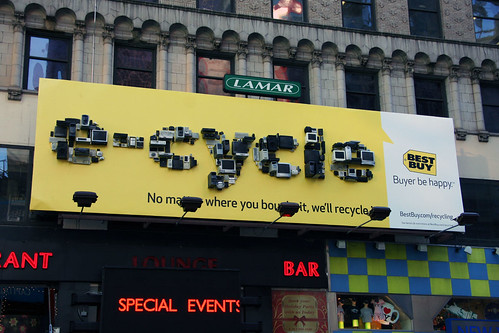
Activity - Investigate the options and end fate of your household’s e-waste. Discuss where and how you will dispose of this waste and your future electronics purchase plans in relation to the waste they will one day become.
Many electronic device contain unknown amounts of ridiculously dangerous chemicals, all to make our lives easier, but whose complains, only mother nature. Finding a proper disposal site for electronics is becoming an easier task than it used to be. Many large electronic stores now take back what you bought from them as E-waste. This is a responsible action, by keeping dangerous amounts of toxins out of landfill but what happens to waste products. Two things, one good, one bad. The good is the E-waste is taken to a responsible recycler who uses the proper safety equipment and containment to prevent any contamination to people or the environment. Although a good choice, this process is extremely expensive. This leads to option two, the bad. Some E-waste, or very large amounts, is shipped back to china, here the waste is dispersed from the port in large trucks to very poor villages. Since jobs are a very rare commodity, people will work in more dangerous environments to get paid. The poor are taken advantage of to disassemble and pick apart computers, TV’s, and other electrical components for the valuable metals within. The problem is the workers are unprotected, very underpaid, and it impacts the environment through contamination. E-waste is a very hard product to reuse, and the intense combination of many materials, almost makes it impossible to separate.
E-waste generate at my household ends up back at the electronic store, that has approved techniques for disassembly. I found though that a lot of people have a hard time throwing away electronics, as the initial cost was so much, and they end up sitting in the back of the closet for years, until rediscovered as antiques, like Nintendo. I guess that could be option three for recycling, the option of reusing or rediscovering happiness.
Many large producers of electronics are taking note of what consumers are looking for in new items, and are creating TV’s and computers that have less toxins. One of the most recent selling items I experienced was a mercury free flat screen TV’s, even with auto dim when no one is watching to conserve energy. The market is going in the right direction, and manufactures are pushing this way because it is easier to reuse metals that are already mined and processed, than having to always mine for new minerals. In the end going greener should make the market place a more affordable place to spend hard earned money.
For more information follow the link to RCT a recycling company
Wednesday, April 7, 2010

Blog 6 - - - Reflections - Sludge
Where does your sludge go? Does this surprise you?
The entire concept of waste removal is more or less a hidden operation, just a whole in the ground, there one second gone the other. Watching the waste management movies in class really make everyone realize the large scale operation that needs to take place for society to exist. The sewer system is probably the number one system that is over looked for continence. Based just north of the city of Winnipeg, but still have a connecting to the city grid for waste removal. The waste produced from my area is routed to the Winnipeg north end plant for treatment. To the general public this seems like a good controlled operation and nothing to worry about, other than a slight smell. The truth is that the dual share system, in older Winnipeg isn’t the ideal solution for waste management. Since water and waste water share the same pipes, the treatment plant can become overloaded and forces to dump, unprocessed sewage, directly into the river. While doing this article, I was informed that the rapid melting and increasing flood waters has put enough strain on the system to cause it to purge untreated material for 5 hours this past weekend. Know the impacts of these actions can surprise people initially, but then brush it off as “there enough water in the river to dilute it”, but reality is that the nitrates and phosphors’ are going to have a much large impact downstream. The rate of nitrification taking place in lake Winnipeg is direct proof of the impact of releasing untreated water into the water ways flowing through the city. The lake is becoming a dead zone, impacting the community and the local economy. These large changes happen very quickly, but reversing these effects takes a very long time, up to 40 years with a natural marsh system. People have to be more responsible when dealing with nitrate charged materials, like in lawn care, and the city has to find a better way of dealing with the sewage problem. A year release rate of 15 time is way too high, to decrease the nitrification in lake Winnipeg. The city will have to come together as a whole to find better ways to cut down on water use, and a more efficient way of eliminating bio wastes.
The entire concept of waste removal is more or less a hidden operation, just a whole in the ground, there one second gone the other. Watching the waste management movies in class really make everyone realize the large scale operation that needs to take place for society to exist. The sewer system is probably the number one system that is over looked for continence. Based just north of the city of Winnipeg, but still have a connecting to the city grid for waste removal. The waste produced from my area is routed to the Winnipeg north end plant for treatment. To the general public this seems like a good controlled operation and nothing to worry about, other than a slight smell. The truth is that the dual share system, in older Winnipeg isn’t the ideal solution for waste management. Since water and waste water share the same pipes, the treatment plant can become overloaded and forces to dump, unprocessed sewage, directly into the river. While doing this article, I was informed that the rapid melting and increasing flood waters has put enough strain on the system to cause it to purge untreated material for 5 hours this past weekend. Know the impacts of these actions can surprise people initially, but then brush it off as “there enough water in the river to dilute it”, but reality is that the nitrates and phosphors’ are going to have a much large impact downstream. The rate of nitrification taking place in lake Winnipeg is direct proof of the impact of releasing untreated water into the water ways flowing through the city. The lake is becoming a dead zone, impacting the community and the local economy. These large changes happen very quickly, but reversing these effects takes a very long time, up to 40 years with a natural marsh system. People have to be more responsible when dealing with nitrate charged materials, like in lawn care, and the city has to find a better way of dealing with the sewage problem. A year release rate of 15 time is way too high, to decrease the nitrification in lake Winnipeg. The city will have to come together as a whole to find better ways to cut down on water use, and a more efficient way of eliminating bio wastes.
Blog 6 - - - Class Reflections - Movie - Fat Lake
The movie explains how too much of a good thing can have very large negative impacts. The troubles area caused by nitrification from too much phosphorus run off, killing the lake, by taking up all the oxygen. Humans have increased the amount of phosphorus in nature through many processes. The site of the lake collects 950,000 square kilometres of land run off, greatly increasing growth rates form the increased levels of nitrogen and phosphorus. This is leading to a much higher biomass, but it is starving the water for oxygen, as the algae takes over. Surrounding marshes are an excellent natural filter, but are now being over whelmed, and marshes are disappearing, turning into lifeless lakes themselves. The number of marshes has dropped from 10% to 0.01% in the red river basin. The blue green algae is taking over from the nitrification, and the end of season die off is starving the entire lake of oxygen, killing fish and other forms of life, overall it creates dead zone. Determining who to blame is to much of the current focus, people need to begin taking action themselves to help in the reduction of phosphorus injection points. An example could be moving cattle further away from, or limiting time near watering/river drinking sources. Water needs to be slowed down, so natural filter systems, like marshes, have a chance to absorb nutrients, and to help solve the overgrowth problem.
This movie and many more effective one like it were released at the Manitoba Eco-Network Environmental Film Festival, this was a great event for spreading the word for problems currently being faced, follow the link in the links menu for future dates.
This movie and many more effective one like it were released at the Manitoba Eco-Network Environmental Film Festival, this was a great event for spreading the word for problems currently being faced, follow the link in the links menu for future dates.
Blog 6 - - - Section 33
At the Shrine
Environmental actions have many factors to consider; using just an economic evaluation is ineffective and requires a more detailed understanding. Too often consumer approaches are taken only regarding the economical value of a situation, and only be become problem when resources located on a piece of land become redistricted, showing that current decisions are based around market value and not natural and environmental values. Land is a commodity, changing it in to a monetary value, ignoring ecological equals. Problems arise when people don’t consider themselves consumers, but view themselves as citizen. People enjoy supporting environmental actions as a community, but rarely do little on a personal level to help the cause. Many people will vote for a carbon tax, but continue to drive inefficient cars, or disapprove the use of harmful chemicals and still use phosphorous cleaning agents. Some recent changes in decision making, has instated the use of the Cost-Benefit analysis. This helps bring economic goals down from the spot light, and uses a more rounded approach to consider apparent regulations, infused with more aesthetics and morals. When determining safety compared to efficient using this kind of model, it tend to fall apart in some ways. People working in dangerous environments become part of the cost-benefit, and in doing so have a price put on there worth. When trying to improve working conditions, arguments have to be made to prove that a safer environment is worth it in the long run. This seem very unfair to the workers, as safer practices are available, but company regulations say it to expensive to make them better. This makes people expendable, and viewed only as a piece of the process. Workings around dangerous chemicals have many unknown long term effect, and not using the safest equipment seem unjust. The really focus should be how safe is the work place, if it cost to much. The cost-benefit analysis tries to improve the decision making process by adding value to equal parties. The downfall is the decision revolves around the people who are financing the decision; still making the overall decision one sided. To improve this attempt of a solution, a neutral part is required to mitigate the arguments, mostly in the form of an economist, and prevent the argument from turning into a money battle. Using this kind of modified decision making process more equal to all parties, as a detailed debate can determine, on all factors. Using this approach also disallows the market from taking charge, and using demand to strong arming a decision. The throughout solutions can provide the best, positive, safe, and aesthetic solution.
I think it is the work places responsibility to proved the safest environment as technologically possible, dependent not on money, but the chemical being used in production. Since many chemical lack long term testing, putting low values on workers is unfair when making decisions. If the cost-benefit analysis is going to be used, and long term effects of the chemicals cannot, or have not been proven yet, workers health should be priceless. Using a high value for life on the job will greatly reduce the amount of cancer causing agents exposed while processing. Applying this thinking to land decisions can be quite similar. Until the effects of a chemical can be proven, land should also be viewed as priceless. Natural environments only happen once, if there destroyed, they eventually disappear, along with their vital functions that we depend on.
Environmental actions have many factors to consider; using just an economic evaluation is ineffective and requires a more detailed understanding. Too often consumer approaches are taken only regarding the economical value of a situation, and only be become problem when resources located on a piece of land become redistricted, showing that current decisions are based around market value and not natural and environmental values. Land is a commodity, changing it in to a monetary value, ignoring ecological equals. Problems arise when people don’t consider themselves consumers, but view themselves as citizen. People enjoy supporting environmental actions as a community, but rarely do little on a personal level to help the cause. Many people will vote for a carbon tax, but continue to drive inefficient cars, or disapprove the use of harmful chemicals and still use phosphorous cleaning agents. Some recent changes in decision making, has instated the use of the Cost-Benefit analysis. This helps bring economic goals down from the spot light, and uses a more rounded approach to consider apparent regulations, infused with more aesthetics and morals. When determining safety compared to efficient using this kind of model, it tend to fall apart in some ways. People working in dangerous environments become part of the cost-benefit, and in doing so have a price put on there worth. When trying to improve working conditions, arguments have to be made to prove that a safer environment is worth it in the long run. This seem very unfair to the workers, as safer practices are available, but company regulations say it to expensive to make them better. This makes people expendable, and viewed only as a piece of the process. Workings around dangerous chemicals have many unknown long term effect, and not using the safest equipment seem unjust. The really focus should be how safe is the work place, if it cost to much. The cost-benefit analysis tries to improve the decision making process by adding value to equal parties. The downfall is the decision revolves around the people who are financing the decision; still making the overall decision one sided. To improve this attempt of a solution, a neutral part is required to mitigate the arguments, mostly in the form of an economist, and prevent the argument from turning into a money battle. Using this kind of modified decision making process more equal to all parties, as a detailed debate can determine, on all factors. Using this approach also disallows the market from taking charge, and using demand to strong arming a decision. The throughout solutions can provide the best, positive, safe, and aesthetic solution.
I think it is the work places responsibility to proved the safest environment as technologically possible, dependent not on money, but the chemical being used in production. Since many chemical lack long term testing, putting low values on workers is unfair when making decisions. If the cost-benefit analysis is going to be used, and long term effects of the chemicals cannot, or have not been proven yet, workers health should be priceless. Using a high value for life on the job will greatly reduce the amount of cancer causing agents exposed while processing. Applying this thinking to land decisions can be quite similar. Until the effects of a chemical can be proven, land should also be viewed as priceless. Natural environments only happen once, if there destroyed, they eventually disappear, along with their vital functions that we depend on.
Blog 6 - - - Section 31
Living Downstream
The use of toxic chemicals in our everyday lives might have greater impacts than originally thought. More research has to be done to identify the cause and point source of cancer causing chemicals. People have to realize that the environment plays a large role in caner causing problem, more than genetically inherited traits. Understanding the cause of cancer is one thing, but having the public awareness of the effects, symptoms, and how to check for the dieses is another. Cancer consists of a very settle change in the DNA structures, making it difficult to recognize and find solutions. In the case from the article, bladder cancer is started, or caused, from carcinogens making contact with the cell walls, most notably from aromatic amines. The use of many chemicals to do daily processes can cause major effects to the human body, some resulting in cancer. These effects are noticed usually in industrial settings, where large amounts of workers are suffering from similar problems. Aromatic amines affect vast amounts of people, from their surround environment, in small quantities. This type of carcinogen was also the first type to be discovered, due to the large effect on humans. This cancer relies on the environment to infect. For example 1/3 of this cancer is related to cigarette smoke, first or second hand. Also industrially contaminated water has be proven to be a large problem, even in trace amounts. The danger of using untested chemicals becomes apparent, as these cancers causing agents are used throughout the U.S., with little to no restriction, because until now the effects weren’t known. Current research efforts are working on finding hereditary and acquired cancer origins, and if they do have substantial impacts in increasing the chance of contracting cancer. People have the right to know about health risk, especially environmental hazard, like spring hill. Susceptible traits that are inherited tend to have a increased risk when facing a hazardous environment, greatly increasing the need of awareness. To grasp the problem with chemical pollution, one must look at the past, future, and present. The past provides information, and a understanding on how the impact today originated, and possibly the type of chemical. The present looks at human rights and the use of untested chemicals. Banning there use can prevent many unknown problems that can occur in future generations, in the same way the past is effect the present right now. This chemical contamination is a leading cause of death throughout the U.S., and solutions need to be found to prevent further pollution hazards. The use of the “principal of the least toxic alternative” ensures that the most environmentally friendly options/products will be used first before toxic alternatives are though of. Our views have to move from “how much toxic chemicals are acceptable”, to “What alternative ways are there instead”.
The use of toxic chemical is necessary in some setting, but a lot of the time are used and abused beyond their intended use. This kind of thinking takes away from the overall health of communities. Chemical need to be responsible used, as one bad choice today, may effect many generations in the future. The speed at which chemicals are being produce, so should the amount of proper disposal sites. More options and education of the options for dealing with unwanted chemical waste, will greatly reduce the illegal dumping, and corporations with government influence, to hide there expensive wastes. Providing education to dumpers, might make them realizes that harmless chemical apart might form deadly strains when combined. It is also important that testing should be done on chemical before they are released, to understand potential impacts of human and the natural environment. Safety should always be first.
The use of toxic chemicals in our everyday lives might have greater impacts than originally thought. More research has to be done to identify the cause and point source of cancer causing chemicals. People have to realize that the environment plays a large role in caner causing problem, more than genetically inherited traits. Understanding the cause of cancer is one thing, but having the public awareness of the effects, symptoms, and how to check for the dieses is another. Cancer consists of a very settle change in the DNA structures, making it difficult to recognize and find solutions. In the case from the article, bladder cancer is started, or caused, from carcinogens making contact with the cell walls, most notably from aromatic amines. The use of many chemicals to do daily processes can cause major effects to the human body, some resulting in cancer. These effects are noticed usually in industrial settings, where large amounts of workers are suffering from similar problems. Aromatic amines affect vast amounts of people, from their surround environment, in small quantities. This type of carcinogen was also the first type to be discovered, due to the large effect on humans. This cancer relies on the environment to infect. For example 1/3 of this cancer is related to cigarette smoke, first or second hand. Also industrially contaminated water has be proven to be a large problem, even in trace amounts. The danger of using untested chemicals becomes apparent, as these cancers causing agents are used throughout the U.S., with little to no restriction, because until now the effects weren’t known. Current research efforts are working on finding hereditary and acquired cancer origins, and if they do have substantial impacts in increasing the chance of contracting cancer. People have the right to know about health risk, especially environmental hazard, like spring hill. Susceptible traits that are inherited tend to have a increased risk when facing a hazardous environment, greatly increasing the need of awareness. To grasp the problem with chemical pollution, one must look at the past, future, and present. The past provides information, and a understanding on how the impact today originated, and possibly the type of chemical. The present looks at human rights and the use of untested chemicals. Banning there use can prevent many unknown problems that can occur in future generations, in the same way the past is effect the present right now. This chemical contamination is a leading cause of death throughout the U.S., and solutions need to be found to prevent further pollution hazards. The use of the “principal of the least toxic alternative” ensures that the most environmentally friendly options/products will be used first before toxic alternatives are though of. Our views have to move from “how much toxic chemicals are acceptable”, to “What alternative ways are there instead”.
The use of toxic chemical is necessary in some setting, but a lot of the time are used and abused beyond their intended use. This kind of thinking takes away from the overall health of communities. Chemical need to be responsible used, as one bad choice today, may effect many generations in the future. The speed at which chemicals are being produce, so should the amount of proper disposal sites. More options and education of the options for dealing with unwanted chemical waste, will greatly reduce the illegal dumping, and corporations with government influence, to hide there expensive wastes. Providing education to dumpers, might make them realizes that harmless chemical apart might form deadly strains when combined. It is also important that testing should be done on chemical before they are released, to understand potential impacts of human and the natural environment. Safety should always be first.
Blog 6 - - - Section 20
Impacts of biodiversity loss on ocean ecosystem services
Humans rely heavily on natural process and diversity of species to harvest abundant crops and wild life, such as wheat and fish. The human impacts on the environment are beginning to take an unknown toll on many ecosystems. Resource collapses are increasing, as recovery rates, stability, and quality are decreasing, resulting from the loss of diversity. In the marine setting, dealing with fish, has a link between biodiversity and the amount of food, fish for humans, the ocean can produce. Trying to increase diversity is very difficult, but decreasing it is very easy. The loss of diversity is a result of exploitation, pollution, and habitat destruction. Experiments have also shown the importance of diversity, not only in species, but also in food sources. The combination of both factors has shown a better rebound and resistance from harmful events. The loss of biodiversity reduces the following three functions.
•The number of viable fisheries, provisions of nursery habitats, and filtering/detoxification.
•The loss of filtering is a major contributor to the decrease of water quality.
•The loss of natural species from these effects promotes the infiltration of adverse species, simplifying the biodiversity.
Looking at larger marine environments, showed that the simplification of fish species is occurring, as 20% of fish species has already disappeared. This trend was accelerated in areas that had poor species density and food supply. Having good species diversity prove again to be beneficial, in aiding in rebuilding after a major collapse, saving local, native, and diversity. This concept is further backed up by the portfolio effect, where the large amount of fish species in the area allows fishers to switch from species to species, to prevent over fishing on a singular species, but still allowing for a large enough catch to feed a community. Resources and fishery closures are currently being reused as large scale experiments. They are being used to test the effects of regeneration of fish density and diversity. It has been proven that regeneration is possible when the proper control is placed on additive, activities, and tourism. Protecting diversity and ecosystems is an important issue locally and nationally. The loss of locally adapted populations dramatically reduces stability and recovery rates, rapidly changing the larger marine system. Investment has to be made now in pollution control, fishery limits, and habitat maintenances, to prevent, and to ensure, the economic plans are aware of the values of these systems. The loss of the function of the systems would put global food security, water quality, and economic stability at risk and pushing out problems now, on to future generations.
Understanding the importance of the fishing community, and the importance of a health water systems, put a great responsibility on the people that rely on both systems for food and drinking water. Fishing communities need to understand that overfishing will only make life harder in the coming years. Taking what is an only needed and switching type of fish during times of the year, will allow the natural ecosystems to produce more fish to be caught as a result, improving life instead. Sometimes being conservative can result in more gains than being aggressive; this though also applies to the use of land and chemicals. Finding more efficient ways to use both can also greatly reduce the impacts on fish populations and food supplies.
Humans rely heavily on natural process and diversity of species to harvest abundant crops and wild life, such as wheat and fish. The human impacts on the environment are beginning to take an unknown toll on many ecosystems. Resource collapses are increasing, as recovery rates, stability, and quality are decreasing, resulting from the loss of diversity. In the marine setting, dealing with fish, has a link between biodiversity and the amount of food, fish for humans, the ocean can produce. Trying to increase diversity is very difficult, but decreasing it is very easy. The loss of diversity is a result of exploitation, pollution, and habitat destruction. Experiments have also shown the importance of diversity, not only in species, but also in food sources. The combination of both factors has shown a better rebound and resistance from harmful events. The loss of biodiversity reduces the following three functions.
•The number of viable fisheries, provisions of nursery habitats, and filtering/detoxification.
•The loss of filtering is a major contributor to the decrease of water quality.
•The loss of natural species from these effects promotes the infiltration of adverse species, simplifying the biodiversity.
Looking at larger marine environments, showed that the simplification of fish species is occurring, as 20% of fish species has already disappeared. This trend was accelerated in areas that had poor species density and food supply. Having good species diversity prove again to be beneficial, in aiding in rebuilding after a major collapse, saving local, native, and diversity. This concept is further backed up by the portfolio effect, where the large amount of fish species in the area allows fishers to switch from species to species, to prevent over fishing on a singular species, but still allowing for a large enough catch to feed a community. Resources and fishery closures are currently being reused as large scale experiments. They are being used to test the effects of regeneration of fish density and diversity. It has been proven that regeneration is possible when the proper control is placed on additive, activities, and tourism. Protecting diversity and ecosystems is an important issue locally and nationally. The loss of locally adapted populations dramatically reduces stability and recovery rates, rapidly changing the larger marine system. Investment has to be made now in pollution control, fishery limits, and habitat maintenances, to prevent, and to ensure, the economic plans are aware of the values of these systems. The loss of the function of the systems would put global food security, water quality, and economic stability at risk and pushing out problems now, on to future generations.
Understanding the importance of the fishing community, and the importance of a health water systems, put a great responsibility on the people that rely on both systems for food and drinking water. Fishing communities need to understand that overfishing will only make life harder in the coming years. Taking what is an only needed and switching type of fish during times of the year, will allow the natural ecosystems to produce more fish to be caught as a result, improving life instead. Sometimes being conservative can result in more gains than being aggressive; this though also applies to the use of land and chemicals. Finding more efficient ways to use both can also greatly reduce the impacts on fish populations and food supplies.
Blog 6 - - - Section 10
Life and death of the salt marsh
Understanding the important factors of salt marches are critical to the conservation of water quality. Salt marshes are located on the coast of the oceans, and can grow on land and float in the ocean. They flourish in tidal zones, from being exposed to the mixture of water and air throughout the day. Marshes create many distinctive features, and they can be used to determine the health of a salt water marsh system. Sounds of bubbling air and the smell of iodine are produced as healthy marshes process and grow, where as polluted marshes change, sounds are reduced and rotten eggs replace the natural smell of the ocean. Healthy marshes also have a correct feeling, the feeling of the ground is squishy, as people walk on it, this shows a good mixture of root, mud, and water concentrations. Even though slat marshes are adaptive to dry and moist environments, human and unnatural process are still the biggest dangers. The human effects these lands directly and indirectly with many types of pollution and development. Destruction of wetland is always going to be a way of life, every year small percentages disappear from the building communities, or roads to access the wetlands themselves. Some wetlands are also being altered to control mosquito populations. Wetland damage can be reduced by limiting land access and increasing water access, reducing the amount of human infrastructure placed though out nature. The nation as a whole have to plan the controlled modifications of these wetlands, to reduce the overall impact, as wetland work a together over thousands of mile, and local impacts can hamper the effectiveness of the entire system. A major problem is corporate black mail happening within coastal communities. Corporations threaten to leave towns if wetland cannot be set aside for their in building expansion, instead of being used as a park or natural reserve. This is an unfair fight for conservation, as the marsh systems are challenged every year for development, causing them to constantly fight to save it, where as the builders only have to win the argument once, because then the land is changed forever with construction. The large size of these systems, east coast of North America, makes it difficult to protect. The substantial size of salt marshes is vital for the health function to continue to exist, more effort needs to be put forth to protect this natural filter.
Salt marshes are becoming more rare every day, from development by people that do not understand there critical service to the environment. People have to become aware of the effectiveness of these marsh systems, at keeping our pollution out of our drinking waters and oceans. Government enforces laws, on a national level, will make it harder for developers to gain building permits on these delicate systems, preserving the large system on the east coast. The government could also control access regulation, but increasing their uses as parks, but from water access to reduce the overall impacts.
Understanding the important factors of salt marches are critical to the conservation of water quality. Salt marshes are located on the coast of the oceans, and can grow on land and float in the ocean. They flourish in tidal zones, from being exposed to the mixture of water and air throughout the day. Marshes create many distinctive features, and they can be used to determine the health of a salt water marsh system. Sounds of bubbling air and the smell of iodine are produced as healthy marshes process and grow, where as polluted marshes change, sounds are reduced and rotten eggs replace the natural smell of the ocean. Healthy marshes also have a correct feeling, the feeling of the ground is squishy, as people walk on it, this shows a good mixture of root, mud, and water concentrations. Even though slat marshes are adaptive to dry and moist environments, human and unnatural process are still the biggest dangers. The human effects these lands directly and indirectly with many types of pollution and development. Destruction of wetland is always going to be a way of life, every year small percentages disappear from the building communities, or roads to access the wetlands themselves. Some wetlands are also being altered to control mosquito populations. Wetland damage can be reduced by limiting land access and increasing water access, reducing the amount of human infrastructure placed though out nature. The nation as a whole have to plan the controlled modifications of these wetlands, to reduce the overall impact, as wetland work a together over thousands of mile, and local impacts can hamper the effectiveness of the entire system. A major problem is corporate black mail happening within coastal communities. Corporations threaten to leave towns if wetland cannot be set aside for their in building expansion, instead of being used as a park or natural reserve. This is an unfair fight for conservation, as the marsh systems are challenged every year for development, causing them to constantly fight to save it, where as the builders only have to win the argument once, because then the land is changed forever with construction. The large size of these systems, east coast of North America, makes it difficult to protect. The substantial size of salt marshes is vital for the health function to continue to exist, more effort needs to be put forth to protect this natural filter.
Salt marshes are becoming more rare every day, from development by people that do not understand there critical service to the environment. People have to become aware of the effectiveness of these marsh systems, at keeping our pollution out of our drinking waters and oceans. Government enforces laws, on a national level, will make it harder for developers to gain building permits on these delicate systems, preserving the large system on the east coast. The government could also control access regulation, but increasing their uses as parks, but from water access to reduce the overall impacts.
Thursday, March 25, 2010
Blog 5 - - - Section 39
39 – Towards Sustainability Development
Sustainable development is providing the necessities of today, without disadvantaging our needs of the futures. This concept applies for everyone, developed to undeveloped, and central to market oriented. Mind set has to remain broad, but with a strategic purpose towards social and physical equality. Current needs are unmeet in third world countries, which have unequal shares and are unable to live sustainably. Creating sustainable societies requires equal rights and opportunities for all, without exploitation of others. Populations must also be controlled to be in harmony with ecological and economic growth. The natural system has to be present, but changes induced by humans are modifying the delicate system in unnatural ways. The limits have to be realized before they are reached, to relive pressure and the potential of a large disaster. Land modifications can occur, like mining and farming, but planning has to be done first. Understanding erosion and regeneration rates allows for the use of renewable resources in a sustainable manner. It’s all about understanding the overall impact of an action, and calibrating the depletion rates to recognize future problems. Finding equity relies on educations, development, and laws that are enforced. These structures prevent responsibility avoiding, and provides a better source of information for the public, so overall choices are well thought out on the possible impacts as a result. Making the world more sustainable requires the rebalancing of technology; bring more resources to the third world environment. Third world environment have to become less dependent and dispersing focused consumptions, to a more moderate levels worldwide. Simply moving technologies isn’t the answer. New practices in more conservative uses of materials and environmental impacts, combining new technologies and techniques allows developing countries to be less dependent on finite resources. Eliminating segmentation between the environment and economy allows sustainable development to flourish, but still remains a barrier in today’s processes. Laws can be used to make systems better, limiting damage, but the perfect system would be public decision based, allowing society to have control over sustainable issues. In large scale, sustainability is to promote harmony between humanity and nature, by having citizen decision making privileges, a surplus economy, respects the obligation to preserve the environment, and a system that incorporates flexibility and self correction. These goals taken seriously will benefit the sustainability of all countries, promoting a better well being as a whole now and in the future.
For actions regarding sustainability to happen, the world will have to dramatically change from a profit based economy, to a responsible conservative approach. Even though large resistance would be met initially, the world economy and population will realized turning sustainable is necessary for natural vital systems to continue to function. Reducing the impacts of the developed world, and increasing efficiency in the less developed, can create balance, and the soon the world can realized this fact, the soon our impacts will stop effecting the environment in such a dramatic way.
Sustainable development is providing the necessities of today, without disadvantaging our needs of the futures. This concept applies for everyone, developed to undeveloped, and central to market oriented. Mind set has to remain broad, but with a strategic purpose towards social and physical equality. Current needs are unmeet in third world countries, which have unequal shares and are unable to live sustainably. Creating sustainable societies requires equal rights and opportunities for all, without exploitation of others. Populations must also be controlled to be in harmony with ecological and economic growth. The natural system has to be present, but changes induced by humans are modifying the delicate system in unnatural ways. The limits have to be realized before they are reached, to relive pressure and the potential of a large disaster. Land modifications can occur, like mining and farming, but planning has to be done first. Understanding erosion and regeneration rates allows for the use of renewable resources in a sustainable manner. It’s all about understanding the overall impact of an action, and calibrating the depletion rates to recognize future problems. Finding equity relies on educations, development, and laws that are enforced. These structures prevent responsibility avoiding, and provides a better source of information for the public, so overall choices are well thought out on the possible impacts as a result. Making the world more sustainable requires the rebalancing of technology; bring more resources to the third world environment. Third world environment have to become less dependent and dispersing focused consumptions, to a more moderate levels worldwide. Simply moving technologies isn’t the answer. New practices in more conservative uses of materials and environmental impacts, combining new technologies and techniques allows developing countries to be less dependent on finite resources. Eliminating segmentation between the environment and economy allows sustainable development to flourish, but still remains a barrier in today’s processes. Laws can be used to make systems better, limiting damage, but the perfect system would be public decision based, allowing society to have control over sustainable issues. In large scale, sustainability is to promote harmony between humanity and nature, by having citizen decision making privileges, a surplus economy, respects the obligation to preserve the environment, and a system that incorporates flexibility and self correction. These goals taken seriously will benefit the sustainability of all countries, promoting a better well being as a whole now and in the future.
For actions regarding sustainability to happen, the world will have to dramatically change from a profit based economy, to a responsible conservative approach. Even though large resistance would be met initially, the world economy and population will realized turning sustainable is necessary for natural vital systems to continue to function. Reducing the impacts of the developed world, and increasing efficiency in the less developed, can create balance, and the soon the world can realized this fact, the soon our impacts will stop effecting the environment in such a dramatic way.
Blog 5 - - - Section 24
24 – Restoring Rivers
Humans and natural life are reliant on fresh water systems, such as streams and rivers. Human actions have fouled these resources and action has to be taken to restore essential ecological and social factors. Problems with water systems range from the cleanliness to water shortages from over extraction. This problem impairs 1/3 of the U.S. water ways. The degradation of waterways are putting vital functions, such as flood mitigation, clean drinking water, nutrient and sediment filtration, and the ability to support fisheries and wildlife at risk of disappearing. The poor initial understanding of tributaries and riparian forests during early cities, riverside communities, has been the main source of this problem. Restoration projects are currently engaged, but not to the large extent required to make progress. Positive progress was being made since the 1960’s, until 2004 hit, when it became negative again. This problem is occurring from over development and increased runoff from landscape alterations. Both allow more water to flow faster, unfiltered by nature, and add to the pollution of a stream. The largest effects still remain defused source pollution and warm water “flash floods”, which are warmed from large amounts of heated paved surfaces, killing life in the streams by steep temperature changes. In response to these new problems, the U.S. has enforced stricter runoff laws, more erosion control, and incentives for prevention. This stream saving technology and efforts initial sound good, but problems continue to destroy bays and other runoff gathering points, despite the one billion that has already been injected into the program. Studies and information have to have a more streamline approach to share information and progress that is being made. Some steps being taken include coordinated efforts on the best approaches, previous efforts. National standards will be able to measure the effectiveness of restoration projects, and aid in choosing the best solutions, for given areas. Lastly, national tracking systems to monitor progress and results. The solution will have to consist of federal, state and local efforts to succeed. Promotion of synergy between the three will need to work, to find the ecological solution. Studying pre and post assessments of reconstructed areas is need to improve future efforts, and need to be available to the public. Simple restructuring can provide the bases of a successful river reclaim program. Tracking progress of restoration systems is vital for sharing new techniques and knowledge. Progress will allow the effectiveness of certain techniques to be shared throughout the country. Recording projects and proven techniques will lead to better, more efficient, spending of provided funding. The whole system of projects will begin to work together as one large effort, once again improving water quality of streams and rivers.
This article was interesting in bring up the facts of our past take on our vital systems today. The point that throwing money at a problem won’t fix anything was also a valuable topic. The main factor was organization and working together makes all the difference. Everyone has to be involved to make the changes needed, and for progress in new techniques to be made. Lacking in this system, even on a small scale, has very wide spread impacts, spread as far as the water source flows. Careful monitors and public awareness still remains the key factors for successes.
Humans and natural life are reliant on fresh water systems, such as streams and rivers. Human actions have fouled these resources and action has to be taken to restore essential ecological and social factors. Problems with water systems range from the cleanliness to water shortages from over extraction. This problem impairs 1/3 of the U.S. water ways. The degradation of waterways are putting vital functions, such as flood mitigation, clean drinking water, nutrient and sediment filtration, and the ability to support fisheries and wildlife at risk of disappearing. The poor initial understanding of tributaries and riparian forests during early cities, riverside communities, has been the main source of this problem. Restoration projects are currently engaged, but not to the large extent required to make progress. Positive progress was being made since the 1960’s, until 2004 hit, when it became negative again. This problem is occurring from over development and increased runoff from landscape alterations. Both allow more water to flow faster, unfiltered by nature, and add to the pollution of a stream. The largest effects still remain defused source pollution and warm water “flash floods”, which are warmed from large amounts of heated paved surfaces, killing life in the streams by steep temperature changes. In response to these new problems, the U.S. has enforced stricter runoff laws, more erosion control, and incentives for prevention. This stream saving technology and efforts initial sound good, but problems continue to destroy bays and other runoff gathering points, despite the one billion that has already been injected into the program. Studies and information have to have a more streamline approach to share information and progress that is being made. Some steps being taken include coordinated efforts on the best approaches, previous efforts. National standards will be able to measure the effectiveness of restoration projects, and aid in choosing the best solutions, for given areas. Lastly, national tracking systems to monitor progress and results. The solution will have to consist of federal, state and local efforts to succeed. Promotion of synergy between the three will need to work, to find the ecological solution. Studying pre and post assessments of reconstructed areas is need to improve future efforts, and need to be available to the public. Simple restructuring can provide the bases of a successful river reclaim program. Tracking progress of restoration systems is vital for sharing new techniques and knowledge. Progress will allow the effectiveness of certain techniques to be shared throughout the country. Recording projects and proven techniques will lead to better, more efficient, spending of provided funding. The whole system of projects will begin to work together as one large effort, once again improving water quality of streams and rivers.
This article was interesting in bring up the facts of our past take on our vital systems today. The point that throwing money at a problem won’t fix anything was also a valuable topic. The main factor was organization and working together makes all the difference. Everyone has to be involved to make the changes needed, and for progress in new techniques to be made. Lacking in this system, even on a small scale, has very wide spread impacts, spread as far as the water source flows. Careful monitors and public awareness still remains the key factors for successes.
Blog 5 - - - Section 23
23 – Controversy at Love Canal
It is very important to understand the complete impact of toxic chemicals in the environment. Choices made in the past can create serious problems in the present, causing the intervention from political and scientific communities. Determining the correct method of dealing with toxic chemicals sometimes is based on value more than environmental impact. Toxic substances are hard to recycle and store. Political influence can blur the actual impacts to nearby residents, or even to reuse the land as a safe site for public services, like a school at Love Canal. Toxic chemicals, produced by Hooker in this case, also have people running from responsibility/liability once a contamination occurs. Enforcing laws is very hard when the dumper and law maker were the initial source of the problem, as was the case in Niagara Falls. After substantial problems with local health in the community, the EPA became involved in 1978, almost 20 years too late. The cleanup effort consisted of home evacuation and relocation of resident most at risk. The study produced from the investigation, told residents that the area is safe. No one in the community bought the initial results, as signs of contamination were still present at the site. Unsatisfied by federal studies, local residents took it on their own to survey and identify people in the neighborhood suffering from similar symptoms, believed to be a result from the chemical in the ground. After compiling the data, it was able to show a geographical pattern, with the most effected people to be the closest to the dump site, and banks of the old canal. The results made a positive linear increase in birth defects, compared to homes further away from the banks. The independent study took the likely hood of this occurrence to be “chance” done to .001%. Such birth defects range from serious to mild cases, all of which were occurring at a abnormally high rate, when compared to other neighborhoods. It also gave enough proof to show there was still a contamination and chemical leaking in the area, despite the federal investigation. Surprisingly the controversy was between the community and the health department, and not between the sources of the problem, Hooker Chemicals. The community felt cheated by the public health service. The public health service has a lot to consider for the solutions to the problem at Love Canal. The public health service was delaying to avoid paying out even more than Love Canal itself; there were other sites around the state with the same problem that would demand a payout as well, if a payout was received here. Delaying would make it someone else’s problem as well. The two sides were unable to understand each other’s goals, only adding to the anger from the residents. Information was gathered by one source, the state of New York, putting quality and influence on certain aspects at question. Federal intervention was required to provide an equal and proper study to be conducted. The state became dissident and ignored minority opinions, along with harassment and demotion to keep data consistent, even if it turns out to be false data. Openness of scientific knowledge was compromised, files were hidden and not peer reviewed to establish the validity of the study. There were also no equal attempts at resolving the controversy because the health department responsible for all the data collected refused to acknowledge the deviation from their findings as true, there needs to be an understanding of the problem by both sides, so an actual solution can be made. These problems had two failed attempts at trying to challenge the states data. Following this actions, the state was charged by Senator Thomas Bastosiewicz with everything from withholding information from the public, to manipulation of information to minimize potential health risks. Overall this shows the importance of proper scientific studies, such as openness to data, multiple levels of community involvement, and funds should empower the community to choose their own researcher, all of these points prevent state manipulation.
This article brought up good points about manipulation of the government and power. Having people responsible for investigating their own mistakes and deciding whether or not to pay out from their own pocket never works. Third party investigation is necessary to avoid bias in the information provided and collected. This was a valuable lesson learned by the residents and communities in the area. A restructuring would only benefit the tax payer, and prevent a similar situation from happening again.
It is very important to understand the complete impact of toxic chemicals in the environment. Choices made in the past can create serious problems in the present, causing the intervention from political and scientific communities. Determining the correct method of dealing with toxic chemicals sometimes is based on value more than environmental impact. Toxic substances are hard to recycle and store. Political influence can blur the actual impacts to nearby residents, or even to reuse the land as a safe site for public services, like a school at Love Canal. Toxic chemicals, produced by Hooker in this case, also have people running from responsibility/liability once a contamination occurs. Enforcing laws is very hard when the dumper and law maker were the initial source of the problem, as was the case in Niagara Falls. After substantial problems with local health in the community, the EPA became involved in 1978, almost 20 years too late. The cleanup effort consisted of home evacuation and relocation of resident most at risk. The study produced from the investigation, told residents that the area is safe. No one in the community bought the initial results, as signs of contamination were still present at the site. Unsatisfied by federal studies, local residents took it on their own to survey and identify people in the neighborhood suffering from similar symptoms, believed to be a result from the chemical in the ground. After compiling the data, it was able to show a geographical pattern, with the most effected people to be the closest to the dump site, and banks of the old canal. The results made a positive linear increase in birth defects, compared to homes further away from the banks. The independent study took the likely hood of this occurrence to be “chance” done to .001%. Such birth defects range from serious to mild cases, all of which were occurring at a abnormally high rate, when compared to other neighborhoods. It also gave enough proof to show there was still a contamination and chemical leaking in the area, despite the federal investigation. Surprisingly the controversy was between the community and the health department, and not between the sources of the problem, Hooker Chemicals. The community felt cheated by the public health service. The public health service has a lot to consider for the solutions to the problem at Love Canal. The public health service was delaying to avoid paying out even more than Love Canal itself; there were other sites around the state with the same problem that would demand a payout as well, if a payout was received here. Delaying would make it someone else’s problem as well. The two sides were unable to understand each other’s goals, only adding to the anger from the residents. Information was gathered by one source, the state of New York, putting quality and influence on certain aspects at question. Federal intervention was required to provide an equal and proper study to be conducted. The state became dissident and ignored minority opinions, along with harassment and demotion to keep data consistent, even if it turns out to be false data. Openness of scientific knowledge was compromised, files were hidden and not peer reviewed to establish the validity of the study. There were also no equal attempts at resolving the controversy because the health department responsible for all the data collected refused to acknowledge the deviation from their findings as true, there needs to be an understanding of the problem by both sides, so an actual solution can be made. These problems had two failed attempts at trying to challenge the states data. Following this actions, the state was charged by Senator Thomas Bastosiewicz with everything from withholding information from the public, to manipulation of information to minimize potential health risks. Overall this shows the importance of proper scientific studies, such as openness to data, multiple levels of community involvement, and funds should empower the community to choose their own researcher, all of these points prevent state manipulation.
This article brought up good points about manipulation of the government and power. Having people responsible for investigating their own mistakes and deciding whether or not to pay out from their own pocket never works. Third party investigation is necessary to avoid bias in the information provided and collected. This was a valuable lesson learned by the residents and communities in the area. A restructuring would only benefit the tax payer, and prevent a similar situation from happening again.
Blog 5 - - - Carl Honore – Praises Slowness
Everyone wants to know how to slow down their life, and ironically they want to do it very quickly. The world is stuck in fast-forward, trying to do more and more in less and less time, always racing the clock. Even instant gratification is not fast enough. Today’s current views in advancement see it as being able to accomplish thing faster. People are so accustomed to speed, that they are unaware of the toll of running at such a fast pace. Eventually something has to give, ether peoples bodies or even relationships. These actions bring up the two questions, how did we get so fast? And is it possible to slow down?
The deep driver of this problem is time itself. Our view is time is money and its always running out. People lives begin to revolve around a finish line model. Fortunately slowing down is possible. Slowing down at the right monuments, lets people realize everything thing improves. This is forming the international slow movement. More pleasure and health are the result when more time and effort is put into a project and not burning through the process like a mad man. When a places rethinks how operating slowly would apply, a better connection is made throughout the community. More focus on bettering life, with more parks and less traffic, seeing how theses change add up to more than the sum of their parts, shows the vital role of the slowness movement.
Slowing down in all aspects in one life is very beneficial, from the bedroom to the workplace, people are living better live, working more productive, and overall working the least amount of hours during the week. This happens because people are able to be more relaxed and actually think out actions and plans, avoiding mistakes and making deeper connections in life and business.
People have to make time for the thing usually overlooked in life. Slowing down still remains hard, because speed is fun, and people use it to find distraction, to avoid think about undesired topics. Culture itself has made slow a taboo, linking the term with a slacker or giving up on life. Slow is not always good, but the new idea on slow is, making time for the better thing in life, or just slow down and slaver the important ones life has to offer.
Slowing down is possible in modern society, to avoiding overloading and not wanting to be rushed. The upshot is people are healthier, more productive, and happier. People are living there life and again and not racing through it. Everything becomes deep, rich, and stronger. Not living on a schedule, but taking the necessary time to appreciate the better thing in life.
This clip was a good, new, and refreshing view on life and how it should be. People have to realize life is what they make it, and missing all the details on the way, makes for boring memories. Details are what make people’s lives exciting and unique, Make people become passionate and more connected with loved ones and society. Speed really is a negative influence on modern life, it is necessary during the right application, but life today has it stuck on over drive. After watching this video, slowing down will become a focus and part of my activities. The points made, had good depth, and were easily relatable, motivating people to try slowing down for them selves.
Video can be viewed through links section
Source : TED (2010) “Praises Slowness”, Retreived March 25, 2010, from: http://www.ted.com/talks/lang/eng/carl_honore_praises_slowness.html
The deep driver of this problem is time itself. Our view is time is money and its always running out. People lives begin to revolve around a finish line model. Fortunately slowing down is possible. Slowing down at the right monuments, lets people realize everything thing improves. This is forming the international slow movement. More pleasure and health are the result when more time and effort is put into a project and not burning through the process like a mad man. When a places rethinks how operating slowly would apply, a better connection is made throughout the community. More focus on bettering life, with more parks and less traffic, seeing how theses change add up to more than the sum of their parts, shows the vital role of the slowness movement.
Slowing down in all aspects in one life is very beneficial, from the bedroom to the workplace, people are living better live, working more productive, and overall working the least amount of hours during the week. This happens because people are able to be more relaxed and actually think out actions and plans, avoiding mistakes and making deeper connections in life and business.
People have to make time for the thing usually overlooked in life. Slowing down still remains hard, because speed is fun, and people use it to find distraction, to avoid think about undesired topics. Culture itself has made slow a taboo, linking the term with a slacker or giving up on life. Slow is not always good, but the new idea on slow is, making time for the better thing in life, or just slow down and slaver the important ones life has to offer.
Slowing down is possible in modern society, to avoiding overloading and not wanting to be rushed. The upshot is people are healthier, more productive, and happier. People are living there life and again and not racing through it. Everything becomes deep, rich, and stronger. Not living on a schedule, but taking the necessary time to appreciate the better thing in life.
This clip was a good, new, and refreshing view on life and how it should be. People have to realize life is what they make it, and missing all the details on the way, makes for boring memories. Details are what make people’s lives exciting and unique, Make people become passionate and more connected with loved ones and society. Speed really is a negative influence on modern life, it is necessary during the right application, but life today has it stuck on over drive. After watching this video, slowing down will become a focus and part of my activities. The points made, had good depth, and were easily relatable, motivating people to try slowing down for them selves.
Video can be viewed through links section
Source : TED (2010) “Praises Slowness”, Retreived March 25, 2010, from: http://www.ted.com/talks/lang/eng/carl_honore_praises_slowness.html
Monday, March 15, 2010
Blog 5 - - - Class Reflections - Voluntary Simplicity
This topic is very interesting to consider. It first sound like the minimalist trying to justify living under budget, and trying to justify that money isn’t everything, and actually better to have less money than more. I disagreed with this notion as the class began to examine the topic, think that hard work will give you money, and no money means that not much work is being done.
As the class progressed, this topic of voluntary simplification began to expose its true meaning. Its goal wasn’t to become a stone aged, broke hippy, but to become efficient at living. Making choice on how to spend money more responsibly and be more environmentally friendly. Between the purchases of being a couch to a garden hose, it became clear that is wasn’t the price of the product, but the quality and materials. Choosing better product adds to the products life span and overall use, eliminating products that have to be bought yearly, cutting down on landfill amounts.
Applying this concept of Simplicity is much easier that people think. Seeing how the concept itself can be understood as basic knowledge. Quality to me is a major factor in product construction. Much of my current life style applies to the concepts. Almost all my major purchases throughout my life are still in use today. To me these actions are natural, don’t waste time and money, and make careful purchases that will last. Using a more outward look on society, I do see a lot of actions that are not considerate of this concept. I have to believe than that my upbringing is responsible for my current attitudes. My attitudes today can justify my parent’s choice of having children. They have raised me aware of environmental impacts, to minimize my impact on the environment as a child.
Voluntary Simplicity is a good concept, but I think it is a term that describes ever day life in a Canadian society, and applies more to the lifestyle of the U.S. These actions can be taken as far as desired, and for me it is to be as environmentally friendly as possible, without having to make myself feel left out or unable to do things that I want to do.
As the class progressed, this topic of voluntary simplification began to expose its true meaning. Its goal wasn’t to become a stone aged, broke hippy, but to become efficient at living. Making choice on how to spend money more responsibly and be more environmentally friendly. Between the purchases of being a couch to a garden hose, it became clear that is wasn’t the price of the product, but the quality and materials. Choosing better product adds to the products life span and overall use, eliminating products that have to be bought yearly, cutting down on landfill amounts.
Applying this concept of Simplicity is much easier that people think. Seeing how the concept itself can be understood as basic knowledge. Quality to me is a major factor in product construction. Much of my current life style applies to the concepts. Almost all my major purchases throughout my life are still in use today. To me these actions are natural, don’t waste time and money, and make careful purchases that will last. Using a more outward look on society, I do see a lot of actions that are not considerate of this concept. I have to believe than that my upbringing is responsible for my current attitudes. My attitudes today can justify my parent’s choice of having children. They have raised me aware of environmental impacts, to minimize my impact on the environment as a child.
Voluntary Simplicity is a good concept, but I think it is a term that describes ever day life in a Canadian society, and applies more to the lifestyle of the U.S. These actions can be taken as far as desired, and for me it is to be as environmentally friendly as possible, without having to make myself feel left out or unable to do things that I want to do.
Thursday, March 11, 2010
Blog 4 - - - Activities - Cary Fowler: One seed at a time
Diversity of crops is very important and can be considered genetic resource. The diversity is critical for allowing crops to adapt to changing environments and able to cope with disease. The modification of the natural genetic is crumbling the critical structure for life. Verities of wheat and apples are shrinking at alarming rates, and many verities are now extinct, and streamlining is the main focus over of diversity. Saving only one example of a variety backs us into a corner. The future may require genes from variety that were useless in the past; nothing deserves to be eliminated because the current value is low.
Variety is critical for making climate ready crops. Making crops adapted for higher temperatures is a necessity for preventing a food crisis in Asia and Africa. Maize is the main food source in these countries, and there is only two more growing cycles to improve this crop, action has to be taken now.
Facilities are needed to preserve genetic diversity, such as seed banks. One problem is the mechanical failure and political mismanagement, leading to extinction of certain verities. This has lead to the construction of a building east of Greenland, which is remote and naturally cooled; it works as a backup system for agriculture. This is one of the few example were all the countries of the world have contributed to one project in a friendly manner.
Whatever happens in the future, if crop diversity doesn’t exist, no problems around the world can be solves relating to climate change. The climate is going to change, and the growing environment for plant is also going to change, requiring new diversity to grow throughout the world. Investing now in conservation, might save us in the future.
Genetic diversity is critical component of modern life. New medical and agricultural uses are being discovered daily and solving problem that have been plaguing humanity for centuries. If efforts aren’t made today, current growing areas will become extinct, cultures will go hungry, and world industries will faultier. The globe has to work together to find solutions for preserving genetic diversity and overall humanity.
Video is in related links
Variety is critical for making climate ready crops. Making crops adapted for higher temperatures is a necessity for preventing a food crisis in Asia and Africa. Maize is the main food source in these countries, and there is only two more growing cycles to improve this crop, action has to be taken now.
Facilities are needed to preserve genetic diversity, such as seed banks. One problem is the mechanical failure and political mismanagement, leading to extinction of certain verities. This has lead to the construction of a building east of Greenland, which is remote and naturally cooled; it works as a backup system for agriculture. This is one of the few example were all the countries of the world have contributed to one project in a friendly manner.
Whatever happens in the future, if crop diversity doesn’t exist, no problems around the world can be solves relating to climate change. The climate is going to change, and the growing environment for plant is also going to change, requiring new diversity to grow throughout the world. Investing now in conservation, might save us in the future.
Genetic diversity is critical component of modern life. New medical and agricultural uses are being discovered daily and solving problem that have been plaguing humanity for centuries. If efforts aren’t made today, current growing areas will become extinct, cultures will go hungry, and world industries will faultier. The globe has to work together to find solutions for preserving genetic diversity and overall humanity.
Video is in related links
Blog 4 - - - Class Reflections - Food Intake and environmental impacts
Food intake for the last 48 hours
Day 1
Breakfast
•Fruit shake – Strawberries, Blueberries, bananas, and milk
•Protein bar
Lunch
•Sandwich – Bread, Ham, Tomato, Lettuce, Mayonnaise
•Grapes
•Cucumbers
Dinner
•Steak – BBQ with streak sauce
•Potatoes
•Cesar salad
Day 2
Breakfast
•Fruit shake – Strawberries, Mangos, bananas, and milk
•Protein bar
Lunch
•Sandwich – Bread, Turkey, Tomato, Lettuce, Mayonnaise
•Strawberries
•Cucumbers
Dinner
•Pork – baked with dressings
•Potatoes
•Beans
•Noodles
Looking at the past two day of food consumption, I find that my diet consist of a decently balanced diet. Lots of fruit, and a mix of red and white meat. Also for a good variety of nutrients and minerals. My habits of eating generally lean towards fruit all year round. Most of my fruit are not from local sources and are impacting the environment and me. Fruit from the south during the winter requires large amounts of transportation and generally has a decreased nutritional value. The meat I eat also requires more energy than a more vegetable based diet. Eating higher on the food chain need larger inputs of water, energy, and land. Eating meat is necessary in my life style, but I also believe that there can me improvements made to make the process more environmentally friendly.
During the summer I try to pick my own fruit and vegetables, ether from local gardens or even local farmers markets, relieving some of the strain on the environment. Our climate plays a huge roll in how our society deals with produce and supplies during the sub zero months. Importing is currently our only answer, but new advances in greenhouse technology is making the reality of locally grown produce year round closer and closer. Other processed food, such as noodles also add to the transportation impacts of moving imported food unnecessarily around the country.
This study was a good at bringing out the real impacts of not knowing where our food comes from, next time I’m shopping, ill definitely be more aware of the season and how the products would have got their.
Day 1
Breakfast
•Fruit shake – Strawberries, Blueberries, bananas, and milk
•Protein bar
Lunch
•Sandwich – Bread, Ham, Tomato, Lettuce, Mayonnaise
•Grapes
•Cucumbers
Dinner
•Steak – BBQ with streak sauce
•Potatoes
•Cesar salad
Day 2
Breakfast
•Fruit shake – Strawberries, Mangos, bananas, and milk
•Protein bar
Lunch
•Sandwich – Bread, Turkey, Tomato, Lettuce, Mayonnaise
•Strawberries
•Cucumbers
Dinner
•Pork – baked with dressings
•Potatoes
•Beans
•Noodles
Looking at the past two day of food consumption, I find that my diet consist of a decently balanced diet. Lots of fruit, and a mix of red and white meat. Also for a good variety of nutrients and minerals. My habits of eating generally lean towards fruit all year round. Most of my fruit are not from local sources and are impacting the environment and me. Fruit from the south during the winter requires large amounts of transportation and generally has a decreased nutritional value. The meat I eat also requires more energy than a more vegetable based diet. Eating higher on the food chain need larger inputs of water, energy, and land. Eating meat is necessary in my life style, but I also believe that there can me improvements made to make the process more environmentally friendly.
During the summer I try to pick my own fruit and vegetables, ether from local gardens or even local farmers markets, relieving some of the strain on the environment. Our climate plays a huge roll in how our society deals with produce and supplies during the sub zero months. Importing is currently our only answer, but new advances in greenhouse technology is making the reality of locally grown produce year round closer and closer. Other processed food, such as noodles also add to the transportation impacts of moving imported food unnecessarily around the country.
This study was a good at bringing out the real impacts of not knowing where our food comes from, next time I’m shopping, ill definitely be more aware of the season and how the products would have got their.
Blog 4 - - - Section 41
Women Indigenous Knowledge and biodiversity conservation
Finding and learning from the different views women have on nature and humans use of the environment, Compared to men’s views that are focused on economical gain. Using the view of women, considered the “second sex”, like today’s biodiversity, they are able to look from the less desired side, diversity, and look upon monocultures to see their true destructive, non-progressive ways in industry. Current views of power see diversity and tribal based ways of life to be primitive and outdated, when compared to the powerful progression of mono based ways of life. The biases of monocultures being the only commercial way of making money, leaves diversity with the label of being very inefficient and unproductive. Diverse practices prove to be more employing for many regions of the world where jobs are scarce. Technology to replace labor is good when labor is short or too expensive, but is very damaging when people are willing to work, for reasonable wages, but are denied. Much of the time it leads to poverty in the areas.Lots of labour studies exclude “women’s work” because it is hard to place the many jobs performed, and many are not for wages, just like diversity, its impacts are greater that the economic value, many unseen factors are present. Women’s techniques for producing and managing seeds, allow for long term use and growth, the seed only become stronger. Cooperation’s on the other hand develop over engineered seed, resistant to everything, but designed to die every year, to have repeat customers.
New GMO’s are using patens to protect their products, sealing seed structures produced by nature and used by the third world. These unnatural products have unknown problems, and can be dangerous. Recent concerns with GMO’s have been: Toxins added to modify more structures, Lower nutrient quality, Composition alterations, New allergic reactions to some foods, Rick to domestic animals, and can change habitats. The same cooperation’s that gave us pesticides, are now giving us “green” GMO’s, the effects are still not known, and society as a whole is the new lab test, the test results will be in soon.
Using GMO’s has benefits for areas that find it hard to grow local and necessary food. Should they be released with patens and unknown results, no. People are finding themselves in lawsuits and no seeds to grow due to this ridicule law. Seeing the problem from the other side of the fence allows everyone to take a second look, and see what we missed the first time around. Finding and understanding the no so noticeable connection, that are vital to survival, maybe will let us stop before we have gone too far. It is happening to fast, that our choice to buy GMO’s is shrinking, there should be more clear labelling and always have choice. People should not be so trusting in North America, if anything seeing Europe banning our GMO’s should put huge red flags up.
Finding and learning from the different views women have on nature and humans use of the environment, Compared to men’s views that are focused on economical gain. Using the view of women, considered the “second sex”, like today’s biodiversity, they are able to look from the less desired side, diversity, and look upon monocultures to see their true destructive, non-progressive ways in industry. Current views of power see diversity and tribal based ways of life to be primitive and outdated, when compared to the powerful progression of mono based ways of life. The biases of monocultures being the only commercial way of making money, leaves diversity with the label of being very inefficient and unproductive. Diverse practices prove to be more employing for many regions of the world where jobs are scarce. Technology to replace labor is good when labor is short or too expensive, but is very damaging when people are willing to work, for reasonable wages, but are denied. Much of the time it leads to poverty in the areas.Lots of labour studies exclude “women’s work” because it is hard to place the many jobs performed, and many are not for wages, just like diversity, its impacts are greater that the economic value, many unseen factors are present. Women’s techniques for producing and managing seeds, allow for long term use and growth, the seed only become stronger. Cooperation’s on the other hand develop over engineered seed, resistant to everything, but designed to die every year, to have repeat customers.
New GMO’s are using patens to protect their products, sealing seed structures produced by nature and used by the third world. These unnatural products have unknown problems, and can be dangerous. Recent concerns with GMO’s have been: Toxins added to modify more structures, Lower nutrient quality, Composition alterations, New allergic reactions to some foods, Rick to domestic animals, and can change habitats. The same cooperation’s that gave us pesticides, are now giving us “green” GMO’s, the effects are still not known, and society as a whole is the new lab test, the test results will be in soon.
Using GMO’s has benefits for areas that find it hard to grow local and necessary food. Should they be released with patens and unknown results, no. People are finding themselves in lawsuits and no seeds to grow due to this ridicule law. Seeing the problem from the other side of the fence allows everyone to take a second look, and see what we missed the first time around. Finding and understanding the no so noticeable connection, that are vital to survival, maybe will let us stop before we have gone too far. It is happening to fast, that our choice to buy GMO’s is shrinking, there should be more clear labelling and always have choice. People should not be so trusting in North America, if anything seeing Europe banning our GMO’s should put huge red flags up.
Blog 4 - - - Section 27
The agricultural crisis
Abuse of nature from humans is growing, as out connection to the land is shrinking; Farming has to return to being independent and having a strong co-operation, and flee away from current profit-based farming that instils simplicity. In the beginning, farms were horse and man power, farmers lived on the land that they worked, and everything need for life was grown, for the most part, on their own land. Markets were weekly gathering places, were speciality items were found, a sense of community existed. After world war two, people began using more and more machinery. The new technology made work more manageable, and more land could be farmed by one person. But larger farms meant less people in the country, as labour became more and more scarce.
Future generations are focused on cars, and how fast they can escape the farm after high school. No interest in working hard on the farm, that is not close to a city with entertainment and possessions. Farms are become less profitable, and more of a struggle to manage.
Technologies required for making safe products, like pasteurization, are designed for big business or large scale operations, killing off the small guys, who try and survive with independent products. The equipment requires to large of an investment and initial product to be processed. This in affect is causing forcible displacement for millions of country residents. The attitude of “Being the Biggest” is causing communities to fall apart and makes everyone compete for one spot, to be the biggest. The problem is being caused by politics and agribusiness that are not concerned with farmers and communities, but appeal more to profit and efficiently.
Decisions should be made on culture, not on economic and technology. The driven mitigation from farm to city is simplifying out attitudes, limiting out depth of the overall culture. Our goal for industry now is simplification. People have changed from being completely independent, to understanding a simple task that only completes a fraction of the whole job, mindless work. People no longer are their own boss, with motivation and pride; they are now focused on economics and cultural fashions. Time is another fact becoming important to the everyday farmer, schedules were never used, only judged by how tired and how dark the day was becoming.
This modern process is destroying the character and culture of the farmer’s lifestyle. Something that is learned from decades of experience, compared to a few years of training for a technician. Money becomes the main object, as it can buy more technology to support more land, with less hands. The technology also brings high debt with it as well. Shifting attention from maintaining a product is causing a destructive cycle of competition for attention. The soils are being over worked, and more principals is being spent instead of the interest, this is defiantly not a sustainable way of life.
This “progress” in agriculture is promoting competition instead of interdependence. Chemicals are taking over the land, and nutrients are not being replaced. Monocultures are used for efficiently, and will soon our mistakes will become clearer.
The communities located in the rural areas of the countries are very important. They give us choice of what kind of food we want, and a local source for freshness. The general trend is removing these people from their livelihoods, and people reliant on the food are suffering. Our food system and supply is becoming streamed lined, with less choice and taste, and fewer producers without GMO’s. Understanding how to make the land work and grow is much harder than many tend to believe. The skills are being lost and more chemicals are being used. Once we notice problem with the way me grow food, the skills to return to “how it was” well be lost, and we will have very few alternative to choose from.
Abuse of nature from humans is growing, as out connection to the land is shrinking; Farming has to return to being independent and having a strong co-operation, and flee away from current profit-based farming that instils simplicity. In the beginning, farms were horse and man power, farmers lived on the land that they worked, and everything need for life was grown, for the most part, on their own land. Markets were weekly gathering places, were speciality items were found, a sense of community existed. After world war two, people began using more and more machinery. The new technology made work more manageable, and more land could be farmed by one person. But larger farms meant less people in the country, as labour became more and more scarce.
Future generations are focused on cars, and how fast they can escape the farm after high school. No interest in working hard on the farm, that is not close to a city with entertainment and possessions. Farms are become less profitable, and more of a struggle to manage.
Technologies required for making safe products, like pasteurization, are designed for big business or large scale operations, killing off the small guys, who try and survive with independent products. The equipment requires to large of an investment and initial product to be processed. This in affect is causing forcible displacement for millions of country residents. The attitude of “Being the Biggest” is causing communities to fall apart and makes everyone compete for one spot, to be the biggest. The problem is being caused by politics and agribusiness that are not concerned with farmers and communities, but appeal more to profit and efficiently.
Decisions should be made on culture, not on economic and technology. The driven mitigation from farm to city is simplifying out attitudes, limiting out depth of the overall culture. Our goal for industry now is simplification. People have changed from being completely independent, to understanding a simple task that only completes a fraction of the whole job, mindless work. People no longer are their own boss, with motivation and pride; they are now focused on economics and cultural fashions. Time is another fact becoming important to the everyday farmer, schedules were never used, only judged by how tired and how dark the day was becoming.
This modern process is destroying the character and culture of the farmer’s lifestyle. Something that is learned from decades of experience, compared to a few years of training for a technician. Money becomes the main object, as it can buy more technology to support more land, with less hands. The technology also brings high debt with it as well. Shifting attention from maintaining a product is causing a destructive cycle of competition for attention. The soils are being over worked, and more principals is being spent instead of the interest, this is defiantly not a sustainable way of life.
This “progress” in agriculture is promoting competition instead of interdependence. Chemicals are taking over the land, and nutrients are not being replaced. Monocultures are used for efficiently, and will soon our mistakes will become clearer.
The communities located in the rural areas of the countries are very important. They give us choice of what kind of food we want, and a local source for freshness. The general trend is removing these people from their livelihoods, and people reliant on the food are suffering. Our food system and supply is becoming streamed lined, with less choice and taste, and fewer producers without GMO’s. Understanding how to make the land work and grow is much harder than many tend to believe. The skills are being lost and more chemicals are being used. Once we notice problem with the way me grow food, the skills to return to “how it was” well be lost, and we will have very few alternative to choose from.
Blog 4 - - - Section 28
Food Scarcity
Linking the effect from global warming and over population with the irresponsibility of land use and the effects is has on our food supply. Over using current supplies, such as timber and farmland, is creating less diversification and more desertification. Eventually these factors are going to lead to a econmoic crash, felt most by food producers and third world countries.
The termination of fertile land from mismanagement will cause food prices to rise. These price fluctuations will affect the third world nations much more than the first world. Increasing food prices become extremely vital for increasing world famine overnight, very dangerous for the poor.
The constant increase in population throughout the world is putting strain on land and irrigation systems. Extreme measures are taken to reclaim land and manage water supplies, but as population grows, the amount of land and water per person continues to shrink, making more competition for supplies.
Water shortages are creating competition between urban and irrigation use, both are leading to the drying up of rivers. Crop production relies heavily on irrigation. Water shortages cause countries to import grains, instead of producing the product themselves, reducing work available for their population. Aquifer depletion is a major problem in the world’s three major producers; economic collapse is creeping closer and closer.
Rising food prices might be there wake up call the world has been trying to ignore. Food scarcity is happening already in small scales around the world. It causes the governments to make choice on what is the most vital supplies, most of the time causing riots when favourites are no longer available. Leaving the question of what’s going to happen when it becomes large scale. Low harvest numbers, from poor growing seasons and high food prices are affecting the food reserves and consistent supply of food required. These affects are slowing of stunting economic growth.
Two determinates necessary to control our future food supplies are population control and climate solutions. Populations have to be controlled and cut down to replacement values and climate change has to be less impacting from fossil fuel consumption, especially in power generation and transportation.
Both land and water use needs to become more efficient than present standards, for the amount of resources that are available. The amount of waste produced from current processes of both vital resources is much too wasteful. If it becomes a major problem, ideas of tax to limit or wean people off of grain feed products, will help cut down on water and land use, keeping food prices relatively lower. It’s up to the current politics to move our current path of deterioration and disruption, to a more sustainable way of life, in both economic and demographic.
The article brings good points to the table. Both population and land use are out of control, exceeding the amount of activity that is sustainable. Action has to be taken now, to prevent the circumstance of finding ourselves in a position with no reverse option. Population control isn’t as bad as people think it might be. People will be able to enjoy life more, with more resources and a better quality of life as a greater population. Land management needs to be viewed as land for the people and not large gains for the few. The monopolies of land currently cause people to become greedy and controlling. The countries need to produce vital products first over profitable ones. Harmony is possible, but restructuring is required before.
Linking the effect from global warming and over population with the irresponsibility of land use and the effects is has on our food supply. Over using current supplies, such as timber and farmland, is creating less diversification and more desertification. Eventually these factors are going to lead to a econmoic crash, felt most by food producers and third world countries.
The termination of fertile land from mismanagement will cause food prices to rise. These price fluctuations will affect the third world nations much more than the first world. Increasing food prices become extremely vital for increasing world famine overnight, very dangerous for the poor.
The constant increase in population throughout the world is putting strain on land and irrigation systems. Extreme measures are taken to reclaim land and manage water supplies, but as population grows, the amount of land and water per person continues to shrink, making more competition for supplies.
Water shortages are creating competition between urban and irrigation use, both are leading to the drying up of rivers. Crop production relies heavily on irrigation. Water shortages cause countries to import grains, instead of producing the product themselves, reducing work available for their population. Aquifer depletion is a major problem in the world’s three major producers; economic collapse is creeping closer and closer.
Rising food prices might be there wake up call the world has been trying to ignore. Food scarcity is happening already in small scales around the world. It causes the governments to make choice on what is the most vital supplies, most of the time causing riots when favourites are no longer available. Leaving the question of what’s going to happen when it becomes large scale. Low harvest numbers, from poor growing seasons and high food prices are affecting the food reserves and consistent supply of food required. These affects are slowing of stunting economic growth.
Two determinates necessary to control our future food supplies are population control and climate solutions. Populations have to be controlled and cut down to replacement values and climate change has to be less impacting from fossil fuel consumption, especially in power generation and transportation.
Both land and water use needs to become more efficient than present standards, for the amount of resources that are available. The amount of waste produced from current processes of both vital resources is much too wasteful. If it becomes a major problem, ideas of tax to limit or wean people off of grain feed products, will help cut down on water and land use, keeping food prices relatively lower. It’s up to the current politics to move our current path of deterioration and disruption, to a more sustainable way of life, in both economic and demographic.
The article brings good points to the table. Both population and land use are out of control, exceeding the amount of activity that is sustainable. Action has to be taken now, to prevent the circumstance of finding ourselves in a position with no reverse option. Population control isn’t as bad as people think it might be. People will be able to enjoy life more, with more resources and a better quality of life as a greater population. Land management needs to be viewed as land for the people and not large gains for the few. The monopolies of land currently cause people to become greedy and controlling. The countries need to produce vital products first over profitable ones. Harmony is possible, but restructuring is required before.
Blog 4 - - - Section 29
Organic vs. Conventional farming
Understanding the benefits of both organic and conventional farming, for both the land and the quality of the end product. Conventional farming can have residual chemicals but higher yield, whereas Organic farming is competitive, but requires fallowing, cutting down on the surface area used each year for production. The search is for a combination of the tow, giving the maximum benefit in the end.
Conventional farming techniques with chemicals benefit and hamper the economy. They are found in water supplies, people, and plants. The over use of chemicals, in today’s practices, creates major problems for the environment and people. Overworked fields have increased runoff and soil erosion, allowing more water, unfiltered, to reach water systems. This effect is creating billions of dollars in the healthcare system and environmental repair/management.
Organic farming has been proven to reduce the need for chemicals and produce almost the same yield initially. Safer practices are available and are gaining in popularity. Such techniques as proper crop rotation and planting procedures allow fields to retain their minerals and control weed growth without the use of residual chemicals.
When comparing Conventional farming and Organic farming, it is found that Conventional farming has higher inputs and outputs initially when the soil is fresh, but begins to deteriorate as chemicals and overuse of the begin to take their effects. The soil erosion, depletion of nutrients, and lower water absorption all add up of the years, making Organic farming to become the favour for end amount of biomass to sell.
Organic farming uses other natural ways of dealing with problems throughout the grow season. By planting per-crops and coverage crops, the fields remain protected from drought and pests. It give the land a rich biomass, constant with large amounts of nutrients, giving the natural method a long term advantage over the use of chemicals.
Organic farming uses no chemicals that require spreading, reducing the overall amount of CO2 released during this operation normally, and also putting more money back into the farmer’s pocket. Even thought Organic farming end results for production may fall below Conventional farming, The organic product fetches a much higher price at market, allowing the farmer to produce less and make more money.
Organic farming isn’t perfect, two major problems faces are nitrate deficiency, and weed competition, but this is based to the topography of the region. These problems can be controlled with good farming practice, such as crop rotation and off season crop cover, keeping the biomass and nitrates where they belong, in the soil.
The main point of Organic farming has been used for thousands of years and is a proven technique for many cultures. Some benefits continue to be soil organic matter, control of water and leeching, less fossil energy used, equal output with less input compared to Conventional techniques, larger profits from less product, recycling of water products, and very sustainable.
This article bring to light the actual effects of current farming practices, in a way that is past the bashing of chemical use, and focus on the impacts of more sustainable practice, that have longer lasting production rates and better quality of produce. The experiments done throughout this article were interesting and gave merit to the points being raised. Organic farming will make a strong come back as the effects of chemicals become more apparent and continued high buy prices for organic crops continue to rise.
Understanding the benefits of both organic and conventional farming, for both the land and the quality of the end product. Conventional farming can have residual chemicals but higher yield, whereas Organic farming is competitive, but requires fallowing, cutting down on the surface area used each year for production. The search is for a combination of the tow, giving the maximum benefit in the end.
Conventional farming techniques with chemicals benefit and hamper the economy. They are found in water supplies, people, and plants. The over use of chemicals, in today’s practices, creates major problems for the environment and people. Overworked fields have increased runoff and soil erosion, allowing more water, unfiltered, to reach water systems. This effect is creating billions of dollars in the healthcare system and environmental repair/management.
Organic farming has been proven to reduce the need for chemicals and produce almost the same yield initially. Safer practices are available and are gaining in popularity. Such techniques as proper crop rotation and planting procedures allow fields to retain their minerals and control weed growth without the use of residual chemicals.
When comparing Conventional farming and Organic farming, it is found that Conventional farming has higher inputs and outputs initially when the soil is fresh, but begins to deteriorate as chemicals and overuse of the begin to take their effects. The soil erosion, depletion of nutrients, and lower water absorption all add up of the years, making Organic farming to become the favour for end amount of biomass to sell.
Organic farming uses other natural ways of dealing with problems throughout the grow season. By planting per-crops and coverage crops, the fields remain protected from drought and pests. It give the land a rich biomass, constant with large amounts of nutrients, giving the natural method a long term advantage over the use of chemicals.
Organic farming uses no chemicals that require spreading, reducing the overall amount of CO2 released during this operation normally, and also putting more money back into the farmer’s pocket. Even thought Organic farming end results for production may fall below Conventional farming, The organic product fetches a much higher price at market, allowing the farmer to produce less and make more money.
Organic farming isn’t perfect, two major problems faces are nitrate deficiency, and weed competition, but this is based to the topography of the region. These problems can be controlled with good farming practice, such as crop rotation and off season crop cover, keeping the biomass and nitrates where they belong, in the soil.
The main point of Organic farming has been used for thousands of years and is a proven technique for many cultures. Some benefits continue to be soil organic matter, control of water and leeching, less fossil energy used, equal output with less input compared to Conventional techniques, larger profits from less product, recycling of water products, and very sustainable.
This article bring to light the actual effects of current farming practices, in a way that is past the bashing of chemical use, and focus on the impacts of more sustainable practice, that have longer lasting production rates and better quality of produce. The experiments done throughout this article were interesting and gave merit to the points being raised. Organic farming will make a strong come back as the effects of chemicals become more apparent and continued high buy prices for organic crops continue to rise.
Blog 4 - - - Class Reflections - Seeds of Change
The introductions of GMO’s are good for making strong crops, and making canola more resilient to harsh conditions. Cross pollination is becoming a major problem. Many crops around GMO’s are finding the engineered seed present tin there natural crops, causing the GMO producers to file lawsuits and cops/lots of perfectly good produce are being destroyed. Farmers are being forced to conform to purchasing GMO’s, or stop growing non-GMO crops to avoid problems.
The GMO’s also make it difficult for crop rotation between broadleaf and cereal based. Spring burn off is requiring stronger, more residual chemicals to be used to accomplish the desired result. The stronger chemical may be present for many years after, potentially decreasing the productivity of the land and the value of crops that grow in succession. GMO’s may be more of a curse in the weeds.
Cross pollination is a major problem for both clearing fields and growing non-GMO’s, without migrational volunteer effects.
The continued development of GMO’s is requiring chemical companies to develop stronger herbicides. Crop insurance on the other hand, does not cover burning or malfunctioning GMO’s that are effected by chemicals that they are support to resist. Putting farmers in the situation of losing profits, both from buying the more expensive seeds, and have less to harvest.
Companies that are developing these GMO’s are not willing to stand behind their product, giving no backing or assurance to the consumer, that the product will event work.
Worst part is how the seeds are affecting the industries domestic and international. Domestically communities are being split apart from famers moving or selling the farm, or even worst are friends telling on other friends if they are growing illegally. Internationally, consumers want nothing to do with the product, making the value of growing it drop dramatically.
The GMO’s are a self reproducing product that will be able to outlast the current trends and maybe even the parent companies responsible for it, so who become responsible in the end for this idea, that has altered nature.
THe trailer is posted in the links section for reference and further exploration.
The GMO’s also make it difficult for crop rotation between broadleaf and cereal based. Spring burn off is requiring stronger, more residual chemicals to be used to accomplish the desired result. The stronger chemical may be present for many years after, potentially decreasing the productivity of the land and the value of crops that grow in succession. GMO’s may be more of a curse in the weeds.
Cross pollination is a major problem for both clearing fields and growing non-GMO’s, without migrational volunteer effects.
The continued development of GMO’s is requiring chemical companies to develop stronger herbicides. Crop insurance on the other hand, does not cover burning or malfunctioning GMO’s that are effected by chemicals that they are support to resist. Putting farmers in the situation of losing profits, both from buying the more expensive seeds, and have less to harvest.
Companies that are developing these GMO’s are not willing to stand behind their product, giving no backing or assurance to the consumer, that the product will event work.
Worst part is how the seeds are affecting the industries domestic and international. Domestically communities are being split apart from famers moving or selling the farm, or even worst are friends telling on other friends if they are growing illegally. Internationally, consumers want nothing to do with the product, making the value of growing it drop dramatically.
The GMO’s are a self reproducing product that will be able to outlast the current trends and maybe even the parent companies responsible for it, so who become responsible in the end for this idea, that has altered nature.
THe trailer is posted in the links section for reference and further exploration.
Wednesday, February 24, 2010
Blog 3 - - - Class Reflections - Food Video
The movie in class on food supply, and understanding of where our food comes from, made very good points on the impacts on nature and humans. Understanding theses key concepts allow people to be more aware and make healthier choices when finding food. Making the link between healthcare and food supply, put into reality where the actual cost are being generated. If you don’t feed someone today, you’ll be paying for their healthcare tomorrow when they become sick. The poor shouldn’t be fed off the left over’s from the rich, a more streamed lined system of equally distributed food will allow society as a whole become more efficient, and with less taxes to pay. If Brazil is able to create an equal food system, then Canada should have no problems, we do have more resources available. An education seems to always become a major factor in any problems being faced. A public that is educated on the benefits of locally grown food and the importance of food safety. This approach will turn the public away from processed foods and more towards naturally grown. It also help to cut down on pollution, by minimizing the amount of transportation required to get from grower to the market. People want to eat good food, but are unable to find cheap or available food, with proper nutrition. Buying from the local market creates a bond between the supplier and the customer, and most of the time brings a community closer, turning grocery shopping into a social event. This system works, but education is required and the change will be slow. If successful, the quality of life for the individual and society will greatly increase. The overall goal remains the same, to change the view of food from a commodity to a common good, leaving no person hungry.
Blog 3 - - - Activities - Edward Burtynsky – Manufactured Landscapes
Being inspired by nature in Canada, Ed is able to capture the dynamics of untouched nature, only formed by geological time. The combination of the human impacts that change the environment dramatically, and the mind thought of the scale of nature, produces photos that inspire and bring disbelief of the amount of power and mass modifications that humans are capable of. The pictures bring sobriety to the actual impacts our thirst less society, and how our landscapes are almost as breath taking as natures, except natures is not corrosive to the environment. Even with some pictures show destruction or pollution, Ed is able to bring a sense of forbidden pleasure to enjoy the beauty of something we would usually protest. The pictures not only focus on the downfalls of humanity, but also the reusing and recycling side, in a way like redemption. Highlighting that human process through industry has many sides, all worth looking at. Through the photos, time and effects can be measured. Good example of extreme modification of a landscape is the three gorges dam. It showed three uses of the same land within one culture, first as being nature, then being developed into cites, only to be disassembled and flooded for power generation. Landscapes within the grasp of humans seem to never be safe; enough people with determination can change anything. Not only modification to structures can be amazing. The presences of people themselves can create a landscape. Many people can create the feeling of warmth or confinement in a picture, whereas the absence of people in a desert can be portrayed as freedom or emptiness. Edward is able to show through his pictures that landscapes are only temporary event, always being changed, ether by natural or human influences.
I have seen his work personally at the ROA, when it was on display. The pictures of ordinarily dismissed objects had me in a trance for minutes at a time looking at the fine details that are usually quickly passed over. Images with such scale and presents allow the onlooker to become deeply connect with not only the photo, but what is creating the photo. Options are formed whether the scene is beautiful, or a tragedy because it ends up being the result of a toxic spill. Ed making the view really thinks about the impacts of current society, and the individual. I find his work amazing and enjoyable to constantly look upon.
I have seen his work personally at the ROA, when it was on display. The pictures of ordinarily dismissed objects had me in a trance for minutes at a time looking at the fine details that are usually quickly passed over. Images with such scale and presents allow the onlooker to become deeply connect with not only the photo, but what is creating the photo. Options are formed whether the scene is beautiful, or a tragedy because it ends up being the result of a toxic spill. Ed making the view really thinks about the impacts of current society, and the individual. I find his work amazing and enjoyable to constantly look upon.
Blog 3 - - - Reflections - Canadian Parks
Canadian parks are designed to offer protection to species and a glimpse of pristine nature to the public. Within the first goal of Canadian parks is a problem, people in large amount are not natural to the environment. The protection side of Canadian parks for wild life is quite good in most cases. Many of the parks are located clearly up north away from population, allowing natural wildlife to live in peace. While on the other hand some parks, such as Banff, are harshly segmented with a highway, disrupting natural wildlife paths and habits. Access also plays a major part of creating parks with government money. People want to enjoy nature and the country that they live in. Unfortunately people face the same problems as wildlife with restrictions. Many parks are great distance away from major cities, and no roads available even for the adventurous. Some parks don’t even allow people to freely walk around, in fear of wildlife attacks. Parks that are located in central areas also dissatisfy nature lovers. Many people enjoy skiing and hiking at national parks, but wildlife seems to be displaced with industry and commercial business. It seems that access to parks by humans and wildlife is a fine balance, and many parks currently are one sided.
The example park of Wapusk has the problem of being very remote, and journeys are usually reserved for researchers and guided tours only. Privileges to roam freely and hunt are reserved to the natives, but is only right seeing how they have lived there for decades. It is hard to bring people to remote locations without roads and large amounts of dangerous wildlife, but solutions are possible. The easiest and most damaging fix would be to construct a road to a section of the park. This would greatly impact the environment, and hasn’t been done for understandable reasons. The current methods of flying in and taking the train seem acceptable, given the amount of people making the journey each year. A major issue to address before masses of uneducated people start pouring north is the large population of polar bears in the park. This is a very hard problem to solve, seeing how the land is technically their habitat. Today large fenced in areas are the only safe zone for people, not to attractive to a visitor. Models from Churchill and there ability to deal with polar bears might be useful for introducing more people to the area. Unfortunately, bring a larger population of people in to the area will require modification to the landscape, with negative impacts. If the park opens up some land for small sensibly controlled development and seasonal hunting regulation, the park might be able to create a balance between protection and access. If no modifications are done, it will continue to be research based visitors in a almost perfect natural park, and to me there is nothing wrong with that.
The example park of Wapusk has the problem of being very remote, and journeys are usually reserved for researchers and guided tours only. Privileges to roam freely and hunt are reserved to the natives, but is only right seeing how they have lived there for decades. It is hard to bring people to remote locations without roads and large amounts of dangerous wildlife, but solutions are possible. The easiest and most damaging fix would be to construct a road to a section of the park. This would greatly impact the environment, and hasn’t been done for understandable reasons. The current methods of flying in and taking the train seem acceptable, given the amount of people making the journey each year. A major issue to address before masses of uneducated people start pouring north is the large population of polar bears in the park. This is a very hard problem to solve, seeing how the land is technically their habitat. Today large fenced in areas are the only safe zone for people, not to attractive to a visitor. Models from Churchill and there ability to deal with polar bears might be useful for introducing more people to the area. Unfortunately, bring a larger population of people in to the area will require modification to the landscape, with negative impacts. If the park opens up some land for small sensibly controlled development and seasonal hunting regulation, the park might be able to create a balance between protection and access. If no modifications are done, it will continue to be research based visitors in a almost perfect natural park, and to me there is nothing wrong with that.
Blog 3 - - - Section 26
Climate Change 2007
The effects of green house gases on the climate and how early and so called “expensive” solutions now, will be substantially cheaper than ignoring the problem, and trying to fix it in the future. Primary impacts of burning fossil fuels and land use change are the effects of CO2 concentrations in the atmosphere. The large amounts present today, blow past post industrial revolution estimates out of the water. Both CO2 and Methane rates have exceeded the natural fluctuation points. Although CO2 and demand for oil has been declining slowly, methane has been increasing and is being blamed on anthropogenic activities. Reasons for the climate to change can be focused on three main sources. Radioactive forcing from green house gases and change in surface albedo are responsible for warming the planet, and anthropogenic contributions, like ash from a volcano, are responsible for adding aerosols and cooling the planet. Current trends in warming are showing to be the warmest in the past 200 years, and with a positive linear progression. The warming effect is causing ice and snow to melt, increasing the amounts of liquid water available and present in the atmosphere. It also directly affects the swelling and rising levels of the sea. Temperature will increases rapidly in some areas like the poles, melting ice, and slowly in others like the equator. Equator changes will create droughts and extreme precipitation. Around the poles the temperature is expected to become warm enough to decrease the amount of permafrost and year to year sea ice. The warmer atmosphere will create problems with heavy evaporation and precipitation. Areas will become “Freshened” and others will contain much more salinity in the oceans. Cold nights and cold days are being replaced with more frequent hot days, and longer lasting heat waves, allowing more turbulent storms to form and impact humanity. Fortunately not all warming has been caused by humans. Links have been made to show the effects of anthropogenic influences. This external force can be shown to affect all the stages of global warming, in a natural cycle. Since local and global feedback on this effect is hard to measure, it is hard to determine how much of an influence there really has been. Current projections of radiation impacts, shows the world has a constant warming over the past eight decades. If current rates were held constant and were to continue, the slow response from ocean warming and cooling could carry the effects well into the future. Solutions for global warming are a very long term project. Goals today revolve around harnessing a controllable rate of temperature, and stop increasing. Technological advances in prediction software have made it possible to show more reliable outcomes, with more variables such as wind and extreme weather. The scenarios still predict that the greatest warming will occur overland at high latitudes, large thawing, and loss of sea ice, more consistent heat waves, and extreme weather increase. One of the noted impacts is the slowing or reversal of the mid-ocean currents, destroying the heat conveyor belt. This would cause major cooling of the oceans and land masses. Finding solutions today will require a better understanding of human’s and nature’s impacts on the climate. We are only half of the problem and even if solutions are found for both contributors, the long resident time of CO2 and its warming effects could be felt until 2300.
Learning about global warming I have always thought of it to be a natural cycle, with minimal influence from humans and fossil fuels. This article was easy to agree as it address both points and there effects. It was interesting to learn that the effect might be felt far into the future, even beyond my expectations. Even though I think parts are more natural than human induced, I strong believe in reducing pollution emission for a healthier lifestyle.
The effects of green house gases on the climate and how early and so called “expensive” solutions now, will be substantially cheaper than ignoring the problem, and trying to fix it in the future. Primary impacts of burning fossil fuels and land use change are the effects of CO2 concentrations in the atmosphere. The large amounts present today, blow past post industrial revolution estimates out of the water. Both CO2 and Methane rates have exceeded the natural fluctuation points. Although CO2 and demand for oil has been declining slowly, methane has been increasing and is being blamed on anthropogenic activities. Reasons for the climate to change can be focused on three main sources. Radioactive forcing from green house gases and change in surface albedo are responsible for warming the planet, and anthropogenic contributions, like ash from a volcano, are responsible for adding aerosols and cooling the planet. Current trends in warming are showing to be the warmest in the past 200 years, and with a positive linear progression. The warming effect is causing ice and snow to melt, increasing the amounts of liquid water available and present in the atmosphere. It also directly affects the swelling and rising levels of the sea. Temperature will increases rapidly in some areas like the poles, melting ice, and slowly in others like the equator. Equator changes will create droughts and extreme precipitation. Around the poles the temperature is expected to become warm enough to decrease the amount of permafrost and year to year sea ice. The warmer atmosphere will create problems with heavy evaporation and precipitation. Areas will become “Freshened” and others will contain much more salinity in the oceans. Cold nights and cold days are being replaced with more frequent hot days, and longer lasting heat waves, allowing more turbulent storms to form and impact humanity. Fortunately not all warming has been caused by humans. Links have been made to show the effects of anthropogenic influences. This external force can be shown to affect all the stages of global warming, in a natural cycle. Since local and global feedback on this effect is hard to measure, it is hard to determine how much of an influence there really has been. Current projections of radiation impacts, shows the world has a constant warming over the past eight decades. If current rates were held constant and were to continue, the slow response from ocean warming and cooling could carry the effects well into the future. Solutions for global warming are a very long term project. Goals today revolve around harnessing a controllable rate of temperature, and stop increasing. Technological advances in prediction software have made it possible to show more reliable outcomes, with more variables such as wind and extreme weather. The scenarios still predict that the greatest warming will occur overland at high latitudes, large thawing, and loss of sea ice, more consistent heat waves, and extreme weather increase. One of the noted impacts is the slowing or reversal of the mid-ocean currents, destroying the heat conveyor belt. This would cause major cooling of the oceans and land masses. Finding solutions today will require a better understanding of human’s and nature’s impacts on the climate. We are only half of the problem and even if solutions are found for both contributors, the long resident time of CO2 and its warming effects could be felt until 2300.
Learning about global warming I have always thought of it to be a natural cycle, with minimal influence from humans and fossil fuels. This article was easy to agree as it address both points and there effects. It was interesting to learn that the effect might be felt far into the future, even beyond my expectations. Even though I think parts are more natural than human induced, I strong believe in reducing pollution emission for a healthier lifestyle.
Blog 3 - - - Section 16
Reinventing the Energy System
Finding the worlds energy system to benefit all, including humans and the environment. Inefficient energy has become too available and cheap for people to even consider the impacts of creating it. Due to the limited resources and now realized pollution problems with fossil fuels, humans may find themselves in a transitional period back to Homo Sapien time, where people were independent, with renewable resources, and strive away from today’s dependent, limited, non-renewable resources. The human population has been shaped through history through the availability and types of power. The current population is beginning to strive away from fossil fuels, leading to a major change effecting the future populations. The reason oil was initially used, was to keep up the demand of the industrial revolution. More power was need and sprawl was occurring, removing industry from housing, creating much larger grids.
A problem with oil today, is that the sources are becoming depleted, but oil using countries have little to no growth in consumption. The main problem is supply the third world countries as they come online as oil dependent countries. These countries face the same problem experienced in the early twentieth century, with health and pollution problems. The types of fuels chosen by societies are really chosen at all. They found by a need to make cheap and easy power, example would be the use of wood until coal was discovered to be more effective, in turn replace coal with the even better fossil fuel. The cycle continues as more and more power is required.
The cycle is changing, many technologies are emerging that are threatening to replace fossil fuels, but this time with still more power, but also much more cleaner. New technologies will depend not on who has the most money and land, but rather who is in the right location. For example who has the most sun, which has the most wind. Many underprovided countries, most third world, can be considered ahead, by having the location and already using small scale renewable energy. The diffusion of renewable energy sources may also lead to more global co-operation, and bring smaller, less developed countries back into the loop.
The change will only occur when the energy used today is not looked at as a commodity, but viewed as something to be valued and saved. Used in respect of the natural environment, giving the planet a new lease on life as being “Renewably Sustainable”.
A topic like this always makes me wonder what direction the human race is headed in. I know understand the driving force behind our decisions, and its power. It’s neat how certain types of power are used and adapted, and even why they are discovered, it’s all for a need of something better. I think our view is pointed in the right direction now, unlike in the past. We need more energy, but our concern is focused around being conservative, sustainable, and efficient. Those three factors only lead to a better world, only problem is finding all the right steps and processes to make it happen.
Finding the worlds energy system to benefit all, including humans and the environment. Inefficient energy has become too available and cheap for people to even consider the impacts of creating it. Due to the limited resources and now realized pollution problems with fossil fuels, humans may find themselves in a transitional period back to Homo Sapien time, where people were independent, with renewable resources, and strive away from today’s dependent, limited, non-renewable resources. The human population has been shaped through history through the availability and types of power. The current population is beginning to strive away from fossil fuels, leading to a major change effecting the future populations. The reason oil was initially used, was to keep up the demand of the industrial revolution. More power was need and sprawl was occurring, removing industry from housing, creating much larger grids.
A problem with oil today, is that the sources are becoming depleted, but oil using countries have little to no growth in consumption. The main problem is supply the third world countries as they come online as oil dependent countries. These countries face the same problem experienced in the early twentieth century, with health and pollution problems. The types of fuels chosen by societies are really chosen at all. They found by a need to make cheap and easy power, example would be the use of wood until coal was discovered to be more effective, in turn replace coal with the even better fossil fuel. The cycle continues as more and more power is required.
The cycle is changing, many technologies are emerging that are threatening to replace fossil fuels, but this time with still more power, but also much more cleaner. New technologies will depend not on who has the most money and land, but rather who is in the right location. For example who has the most sun, which has the most wind. Many underprovided countries, most third world, can be considered ahead, by having the location and already using small scale renewable energy. The diffusion of renewable energy sources may also lead to more global co-operation, and bring smaller, less developed countries back into the loop.
The change will only occur when the energy used today is not looked at as a commodity, but viewed as something to be valued and saved. Used in respect of the natural environment, giving the planet a new lease on life as being “Renewably Sustainable”.
A topic like this always makes me wonder what direction the human race is headed in. I know understand the driving force behind our decisions, and its power. It’s neat how certain types of power are used and adapted, and even why they are discovered, it’s all for a need of something better. I think our view is pointed in the right direction now, unlike in the past. We need more energy, but our concern is focused around being conservative, sustainable, and efficient. Those three factors only lead to a better world, only problem is finding all the right steps and processes to make it happen.
Blog 3 - - - Section 15
More Profit with less carbon
Abundance by design, to understand the benefits of business and the environment through renewable energy sources. Many people fear less carbon use means more pressure on the economy, only the opposite is true. It is cheaper to save fuel and use it efficiently, than it is to buy more fuel and use it wastefully. Less carbon allows more money to be saved and to be reinvested into the acceleration of global growth. New power sources are needed become less carbon dependent, and to cut down on wasteful energy conversion processes. Worst consumer with no benefit is standby power sources. The techniques used to accomplish maximum power conservation have to be explained and taught in detail, for acceptable results to be accomplished. Many small steps taken to add up to one much larger goal is harder to grasp, than one large step to equal one large goal. This is the current problem many people face. Efficiently is beneficial at all points of the service stream. Less power can be generated at the source, and less energy will be unnecessarily wasted at the consumer. Current construction views are much too narrow when it comes to factoring in green technologies, for power saving. The ability to see the broader picture, allows people to see upfront cost of more insulation, may result in no heating or cooling systems at all, making it actually cheaper. Components need to be added with a muilty purpose in mind, instead of many singular components working independent of each other. The benefits are much larger with option one. Initial cost is nothing, when compared to the outcomes of an efficient design. More money is saved in construction and overall operation costs. New techniques for smarter power systems are also safer and much more advanced. By not staying idol with current technologies, markets are accelerated into new materials and practices, bettering current ideas. An example is carbon fiber in cars. The reduction of oil consumption is already in progress, Ethanol and Natural Gas are said to be able to phase of convention oil by 2050. Elimination oil use from the world would not only benefit the environment, political conflicts would stop over natural resources as well. New technologies currently being used, is wind power. Wind is the best producing alternative energy source so far. The installation and running cost still come in much lower that current coal plants, but advances still have to be made to produce more energy.
It has been shown in the 80’s that carbon consumption isn’t need for growth to occur. In fact early in the decade the trend was high efficiently was out pacing economic growth. Allowing countries to grow, and have a shrinking power consumption.
The overall problem of greenhouse gas emissions still remains. Although the prevailing view of fixing the problem is still cheaper than leaving it. People have to understand that results are not going to be instant, and initial costs are actually cheaper than conventional methods. Benefits will come with efficiently, and energy saving choices are just that and not to be viewed as expenditures. Governments have to remove poorly designed incentives to use inefficient technologies and create an open market for new power supplies. The world will benefit both economically and environmentally.
This was an awesome read. I was completely uninformed about the progression of a nation with a even high progression of efficiently. The concept was interesting to explore, and kept me reading to understand the reasoning behind it. The new technologies used for building home and car will only make the world better, the public is beginning to understand the concept, but the governments are lacking behind, I think profits will be made either way, and politicians should stop worrying about making money off of old technologies, new one make money as well.
Abundance by design, to understand the benefits of business and the environment through renewable energy sources. Many people fear less carbon use means more pressure on the economy, only the opposite is true. It is cheaper to save fuel and use it efficiently, than it is to buy more fuel and use it wastefully. Less carbon allows more money to be saved and to be reinvested into the acceleration of global growth. New power sources are needed become less carbon dependent, and to cut down on wasteful energy conversion processes. Worst consumer with no benefit is standby power sources. The techniques used to accomplish maximum power conservation have to be explained and taught in detail, for acceptable results to be accomplished. Many small steps taken to add up to one much larger goal is harder to grasp, than one large step to equal one large goal. This is the current problem many people face. Efficiently is beneficial at all points of the service stream. Less power can be generated at the source, and less energy will be unnecessarily wasted at the consumer. Current construction views are much too narrow when it comes to factoring in green technologies, for power saving. The ability to see the broader picture, allows people to see upfront cost of more insulation, may result in no heating or cooling systems at all, making it actually cheaper. Components need to be added with a muilty purpose in mind, instead of many singular components working independent of each other. The benefits are much larger with option one. Initial cost is nothing, when compared to the outcomes of an efficient design. More money is saved in construction and overall operation costs. New techniques for smarter power systems are also safer and much more advanced. By not staying idol with current technologies, markets are accelerated into new materials and practices, bettering current ideas. An example is carbon fiber in cars. The reduction of oil consumption is already in progress, Ethanol and Natural Gas are said to be able to phase of convention oil by 2050. Elimination oil use from the world would not only benefit the environment, political conflicts would stop over natural resources as well. New technologies currently being used, is wind power. Wind is the best producing alternative energy source so far. The installation and running cost still come in much lower that current coal plants, but advances still have to be made to produce more energy.
It has been shown in the 80’s that carbon consumption isn’t need for growth to occur. In fact early in the decade the trend was high efficiently was out pacing economic growth. Allowing countries to grow, and have a shrinking power consumption.
The overall problem of greenhouse gas emissions still remains. Although the prevailing view of fixing the problem is still cheaper than leaving it. People have to understand that results are not going to be instant, and initial costs are actually cheaper than conventional methods. Benefits will come with efficiently, and energy saving choices are just that and not to be viewed as expenditures. Governments have to remove poorly designed incentives to use inefficient technologies and create an open market for new power supplies. The world will benefit both economically and environmentally.
This was an awesome read. I was completely uninformed about the progression of a nation with a even high progression of efficiently. The concept was interesting to explore, and kept me reading to understand the reasoning behind it. The new technologies used for building home and car will only make the world better, the public is beginning to understand the concept, but the governments are lacking behind, I think profits will be made either way, and politicians should stop worrying about making money off of old technologies, new one make money as well.
Blog 3 - - - Section 4
A Sand County Almanac
Ethical connections made between humans and living and non-living components of nature. A quick choice, such as killing a wolf, can have much larger impacts than expected that can only be completely seen by a mountain. Wolves provide a balance to the deer population, without control the mountain can die from an unbalanced cycle. Too many deer will over graze and over populate, killing both the animal population and wiping out the natural biota. This affects my damage the mountain for many generations, depending on the regeneration cycle, if one ever occurs.
Ethical understanding combines the struggle for survival and social conduct, resulting in civil co-operation among a system. This applies for both ecological and philosophical views. The process begins with individual interaction, only to be advanced to social – individual interaction with democracy and “the golden rule”. Land ethics is difficult because it’s still viewed as property, without determined or defined obligations and/or responsibilities. Land ethics is the last step that in to be taken, and it’s vital for the protection and sustainability of the environment. The natural value of land is overlooked for its economic value. Modern views can be said to be “Outgrown” and substitutes are preferred, like synthetics. Education remains a problem, avoiding the direct topics and continuing to direct land as a economic problem, and overlooked the value of the natural biota. Economist have tried to convince that all land use is centered around economic determinates, or how money can be made.
Ethics are never written down, but are formed as an evolution in the minds of a thinking community. Social approbation controls the right from the wrong and as land ethics move from the individual to the community, the land will become more influenced as “land use” decisions on a larger, more eco-friendly scale.
Ethics are extremely important in the world today, especially with some many dangers to the environment. The idea of land conversion to public decisions will be a hard change. There is large amounts of money invest in land, and I think the approach of introducing responsibilities and regulation to land use will be the easiest, yet still challenging, change to instate. The trend of education throughout the topics this time around really highlights the power of knowledge, and why it’s hard to convince or explain impacts to people who don’t understand completely.
Ethical connections made between humans and living and non-living components of nature. A quick choice, such as killing a wolf, can have much larger impacts than expected that can only be completely seen by a mountain. Wolves provide a balance to the deer population, without control the mountain can die from an unbalanced cycle. Too many deer will over graze and over populate, killing both the animal population and wiping out the natural biota. This affects my damage the mountain for many generations, depending on the regeneration cycle, if one ever occurs.
Ethical understanding combines the struggle for survival and social conduct, resulting in civil co-operation among a system. This applies for both ecological and philosophical views. The process begins with individual interaction, only to be advanced to social – individual interaction with democracy and “the golden rule”. Land ethics is difficult because it’s still viewed as property, without determined or defined obligations and/or responsibilities. Land ethics is the last step that in to be taken, and it’s vital for the protection and sustainability of the environment. The natural value of land is overlooked for its economic value. Modern views can be said to be “Outgrown” and substitutes are preferred, like synthetics. Education remains a problem, avoiding the direct topics and continuing to direct land as a economic problem, and overlooked the value of the natural biota. Economist have tried to convince that all land use is centered around economic determinates, or how money can be made.
Ethics are never written down, but are formed as an evolution in the minds of a thinking community. Social approbation controls the right from the wrong and as land ethics move from the individual to the community, the land will become more influenced as “land use” decisions on a larger, more eco-friendly scale.
Ethics are extremely important in the world today, especially with some many dangers to the environment. The idea of land conversion to public decisions will be a hard change. There is large amounts of money invest in land, and I think the approach of introducing responsibilities and regulation to land use will be the easiest, yet still challenging, change to instate. The trend of education throughout the topics this time around really highlights the power of knowledge, and why it’s hard to convince or explain impacts to people who don’t understand completely.
Blog 3 - - - Section 3
Principals of Conservation
Conserve for nature, or to conserve for human consumption. Conservation began with the forestry industry in 1908, and moved onward from there to other sectors. The term conservation can be broken into three stages, starting with development. The development view prioritized natural resources for the present generation first, to meet all their needs, and for future generations second. Making the goal of conservation more society based, rather than an environmental focus. Even though consumption of natural resources was part of conservation, the second point is more concerned with sustainability. The management of waste produced from using conservation techniques, was a major concern. Interested in minimizing waste produced, many functions and processes were streamed line, or more efficient ways were used. An example would be in the transportation industry, switching from rail to shipping. Waste control became a priority, and eventually leads to the formation and practice of controlling forest fires. Conservation deemed what was acceptable amounts of waste produced in industry and event nature, hence the forest fire control. Even though waste was a problem, providing the information and a clear understanding was an even larger problem. Education and understanding of controllable problems are well understood much in advance, before actions are put into motion to prevent the production of waste. The third point of conservation is resources benefit many and not the profits for the few. Resources should be used in the most efficient way to benefit the most people and to be sustainable. Conservation can be applied to many problems, and is a good tool for applying common sense to make an efficient and ethical decision. Overall conservation adds structure to choices and estimates incomes and impacts from these decisions. Final decisions apply more to benefiting the public as a whole presently and for future generations.
The invention of conservation allows the society the ability to see right from wrong. I think this has many good points, but not a perfect system. Having large amounts of people involved in decision making is a good idea for controlling the future of resource responsibility. The first rule is a bit to consuming for me though, I don’t think that the present resources should be used to their maximum benefit, I think they should be used in a conservative way, not using more than needed. The concept did change the world and the societies that adapted it.
Conserve for nature, or to conserve for human consumption. Conservation began with the forestry industry in 1908, and moved onward from there to other sectors. The term conservation can be broken into three stages, starting with development. The development view prioritized natural resources for the present generation first, to meet all their needs, and for future generations second. Making the goal of conservation more society based, rather than an environmental focus. Even though consumption of natural resources was part of conservation, the second point is more concerned with sustainability. The management of waste produced from using conservation techniques, was a major concern. Interested in minimizing waste produced, many functions and processes were streamed line, or more efficient ways were used. An example would be in the transportation industry, switching from rail to shipping. Waste control became a priority, and eventually leads to the formation and practice of controlling forest fires. Conservation deemed what was acceptable amounts of waste produced in industry and event nature, hence the forest fire control. Even though waste was a problem, providing the information and a clear understanding was an even larger problem. Education and understanding of controllable problems are well understood much in advance, before actions are put into motion to prevent the production of waste. The third point of conservation is resources benefit many and not the profits for the few. Resources should be used in the most efficient way to benefit the most people and to be sustainable. Conservation can be applied to many problems, and is a good tool for applying common sense to make an efficient and ethical decision. Overall conservation adds structure to choices and estimates incomes and impacts from these decisions. Final decisions apply more to benefiting the public as a whole presently and for future generations.
The invention of conservation allows the society the ability to see right from wrong. I think this has many good points, but not a perfect system. Having large amounts of people involved in decision making is a good idea for controlling the future of resource responsibility. The first rule is a bit to consuming for me though, I don’t think that the present resources should be used to their maximum benefit, I think they should be used in a conservative way, not using more than needed. The concept did change the world and the societies that adapted it.
Wednesday, February 3, 2010
Blog 2 - - - Section 12
Ecosystems and Human well-being
Understand current impacts and changing actions to become sustainable in the future. Poor ecosystem management for human gain, over the past fifty years, is proving to have harmful consequences. Over use of an ecosystem, destroys the necessary systems for other groups of people and future generations. Some impacts are serious enough to be irreversible, creating diseases and “dead zones”. Everything that is alive will be affected. Non-managed ecosystem changes can affect many areas. Taking one population out of poverty, can easily slip another population into its place, very fine balance that everyone is part of.
Major human impacts are climate change and nutrient loading, and there full effects will be apparent by the year 2050. The most vulnerable communities are poor rural locations, which rely on the natural system of the ecosystem. Sound management solutions now, can create multiple levels of sustainability for the future. But changes have already begun to occur, and still no action has been taken. The effects on the environment only get worse with time. Creating greater transparency throughout all users will spread responsibility and options. Allowing progress to begin, and involving everyone to accomplish a positive change in the ecosystem.
Problems the ecosystems are facing currently are constantly blamed on human activity. In the past fifty years, serious eco-problems can be linked to the speed of expansion and growth of the modern world. Larger environmental change has been to feed growing populations, and most of the land is converted to controlled agricultural practices, removing drainage and over tilling the land. The continuous change is simplifying the world’s biomass, eliminating unique species. High risk species are located in freshwater habits. Human and animal both require the service of the ecosystems, but human are indirectly adding pollution, limiting their effectiveness on purifying.
Changes have been positive, towards eliminating poverty. Fix one problem and another is created. Feeding everyone on earth, would have a massive toll on the environment, population control remains the focus of a stable sustainable ecosystem.
Understanding possible solutions, weather to wait until a problem arise, or to globally connect the worlds resource, still remains a difficult task, with little answers to help guide the decision. All scenarios have benefits and drawbacks, but a fine balance between human and ecosystem interaction is achievable. History has proven people can live in harmony with the ecosystems. Solutions for hunger are slow, especially in the areas most affected. Ecosystem failure, has a high impact on infant mortality rates, and also brings disease. Disease brings expensive drawback that could otherwise be spent on ecosystem renewal.
Intervention on current practices and ways of life can result in sustainable world by 2050. Life today will not be the same as in the future, if goals are going to be met. The human interaction with nature results in the loss of biodiversity, and people will therefore always be impacting the ecosystems, but it’s our choice on how much we effect.
Bottom line, current operations are not efficient enough to work in harmony with earth ecosystems. Industries have to change quickly to minimize further damage. As a precautionary protection program, human have created, protected ecological areas, to maintain impact free natural growth.
In the search for new substitutes to replace current polluter, the community has to be careful. New alternative are usually more expensive, and history has shown, might even be worse. Switching from wood fires, to fossil fuels, was better for people, much worse for the environment. Understanding indirect and drivers behind decision making is vital. A true system provides education of the processes, shows the values and benefits for both human and ecosystems, and how long the new advancement will take to better connect the community with the surrounding ecosystems.
I found this article hard to follow, and much drier than the rest of the articles previously read. The concept was clear enough to understand that people and the ecosystem is a very balanced machine, also humans are not immune to the changes caused by their own action. In a way, humans should look at their own bodies as environment being effect, and look at possible solution to live better, which in turn should allow a better insight on how ecosystems feel and react.
Reference
Easton T. (2009) Environmental Studies, Sections 12. New York: McGraw-Hill
Understand current impacts and changing actions to become sustainable in the future. Poor ecosystem management for human gain, over the past fifty years, is proving to have harmful consequences. Over use of an ecosystem, destroys the necessary systems for other groups of people and future generations. Some impacts are serious enough to be irreversible, creating diseases and “dead zones”. Everything that is alive will be affected. Non-managed ecosystem changes can affect many areas. Taking one population out of poverty, can easily slip another population into its place, very fine balance that everyone is part of.
Major human impacts are climate change and nutrient loading, and there full effects will be apparent by the year 2050. The most vulnerable communities are poor rural locations, which rely on the natural system of the ecosystem. Sound management solutions now, can create multiple levels of sustainability for the future. But changes have already begun to occur, and still no action has been taken. The effects on the environment only get worse with time. Creating greater transparency throughout all users will spread responsibility and options. Allowing progress to begin, and involving everyone to accomplish a positive change in the ecosystem.
Problems the ecosystems are facing currently are constantly blamed on human activity. In the past fifty years, serious eco-problems can be linked to the speed of expansion and growth of the modern world. Larger environmental change has been to feed growing populations, and most of the land is converted to controlled agricultural practices, removing drainage and over tilling the land. The continuous change is simplifying the world’s biomass, eliminating unique species. High risk species are located in freshwater habits. Human and animal both require the service of the ecosystems, but human are indirectly adding pollution, limiting their effectiveness on purifying.
Changes have been positive, towards eliminating poverty. Fix one problem and another is created. Feeding everyone on earth, would have a massive toll on the environment, population control remains the focus of a stable sustainable ecosystem.
Understanding possible solutions, weather to wait until a problem arise, or to globally connect the worlds resource, still remains a difficult task, with little answers to help guide the decision. All scenarios have benefits and drawbacks, but a fine balance between human and ecosystem interaction is achievable. History has proven people can live in harmony with the ecosystems. Solutions for hunger are slow, especially in the areas most affected. Ecosystem failure, has a high impact on infant mortality rates, and also brings disease. Disease brings expensive drawback that could otherwise be spent on ecosystem renewal.
Intervention on current practices and ways of life can result in sustainable world by 2050. Life today will not be the same as in the future, if goals are going to be met. The human interaction with nature results in the loss of biodiversity, and people will therefore always be impacting the ecosystems, but it’s our choice on how much we effect.
Bottom line, current operations are not efficient enough to work in harmony with earth ecosystems. Industries have to change quickly to minimize further damage. As a precautionary protection program, human have created, protected ecological areas, to maintain impact free natural growth.
In the search for new substitutes to replace current polluter, the community has to be careful. New alternative are usually more expensive, and history has shown, might even be worse. Switching from wood fires, to fossil fuels, was better for people, much worse for the environment. Understanding indirect and drivers behind decision making is vital. A true system provides education of the processes, shows the values and benefits for both human and ecosystems, and how long the new advancement will take to better connect the community with the surrounding ecosystems.
I found this article hard to follow, and much drier than the rest of the articles previously read. The concept was clear enough to understand that people and the ecosystem is a very balanced machine, also humans are not immune to the changes caused by their own action. In a way, humans should look at their own bodies as environment being effect, and look at possible solution to live better, which in turn should allow a better insight on how ecosystems feel and react.
Reference
Easton T. (2009) Environmental Studies, Sections 12. New York: McGraw-Hill
Blog 2 - - - Section 11
Will hurricane Katrina impact shoreline management?
Its going to happen again and again, why are they still building, and rebuilding? Determining when American patriotism should be replaced with realization is a hard task. People love the coastline, but it’s much more dangerous than it looks. Year after year houses are built, and then destroyed by nature, and it still remains a question why people don’t take the insurance and more somewhere safer. It might not be there fault. The government provides funding to rebuild, basically a waste of tax payers money.
Dauphin Island has adopted a new way of life. Constantly cleaning up destruction, and rebuilding houses. A total of five hurricanes have hit the island, with enough power to reshape and divide it in sections. Residents will naturally get the hint to move on, people can’t keep rebuilding forever. The government has different ideas, and still provides insurance and bailout money, keep residents firmly planted in the danger zone.
Beach replenishment is now being used to attract more people, or victims, to the coastline. Hurricanes can heavily impact coastlines, but the same effect is felt with coastline development, both are destructive forces. Coastal developments effect the beaches natural cycle, not allowing sand to return to form new beaches after hurricanes. It’s the houses causing the problems, not nature.
Beaches give the shoreline a safe feeling, promoting population growth and development. Beaches provide some protection against storms, but not much against any storm that has duration on an area. Human mitigation of the shoreline allows great use for people, but utterly destroys a recovering environment, which can take up to two years.
Beach replacement is like bait, it attracts people to the coast, they build, hurricane, everything is destroyed, federal money is injected to promote growth, they rebuild. Once people are situated on the coast from the bait, an endless cycle occurs until people begin to retreat from the coast.
Hopefully the federal government will soon realize, too much money is being wasted to rebuild in unstable areas, over and over again. To compound the problem, rising sea levels and warming oceans, are only promising to bring larger and more powerful storms to the already affected areas.
The federal government has some downfalls on not carrying out coastal retreat. Government is to compassionate to think of not helping the victims of a storm rebuild, medical and rescues will be provided. Residents and government are proud to back down. Leading to the point of being resilient and rebuilding, or is it really just risk taking with a hint of insanity. Coastal communities have to be able to see the risk, to be able to take preventive measures, many are too proud to admit they should have moved last time.
Government itself is to blame, for subsidizing coastal welfare checks for flood insurance and rebuilding. The private insurance sector has already realized to only offer extremely expensive insure to the area, because they know the house “will” be gone in a matter of years. Residents have also developed a dependence on the bailout money when a disaster strikes. In a sane world, the home owner chose to live there, and they should have to pay for living in a dangerous area. If that last statement were true, coastal retreat would be a much faster process.
A fair way of creating a federal retreat program would be to form a committee, to determine which areas are off limits for development, and to aid towns and residents with relocation.
Wetlands and barrier islands around Louisiana are experiencing problems as well. People in the area are also trying to absorb federal money to recreate the “storm protection” of these features. Problem is the destruction of the wetlands is being caused by the use of the levies in the area, none allowing sedimentation to occur. The barrier islands are nothing more than sandbars, providing minimal protection against storm surges. People need to be informed of the problems source before public money is handed out to fix a unfixable problem.
Overall public voice on anti-development is shadowed by large developers for beach front property. Power in number usually wins; the science community needs more support, to help show people the truth and dangers of living on the coast.
Interesting on how people are a creature of habit, even though there is evidence in the past of unfavorable consequences, people believe it won’t happen to them, and to no one’s surprise it always does. I think the government need to step up and move residents after a disaster, instead of rebuilding, no option at all. This would defiantly be a financial gain for the country in the long run, and would end throwing money into the ocean.
Reference
Easton T. (2009) Environmental Studies, Sections 11. New York: McGraw-Hill
Its going to happen again and again, why are they still building, and rebuilding? Determining when American patriotism should be replaced with realization is a hard task. People love the coastline, but it’s much more dangerous than it looks. Year after year houses are built, and then destroyed by nature, and it still remains a question why people don’t take the insurance and more somewhere safer. It might not be there fault. The government provides funding to rebuild, basically a waste of tax payers money.
Dauphin Island has adopted a new way of life. Constantly cleaning up destruction, and rebuilding houses. A total of five hurricanes have hit the island, with enough power to reshape and divide it in sections. Residents will naturally get the hint to move on, people can’t keep rebuilding forever. The government has different ideas, and still provides insurance and bailout money, keep residents firmly planted in the danger zone.
Beach replenishment is now being used to attract more people, or victims, to the coastline. Hurricanes can heavily impact coastlines, but the same effect is felt with coastline development, both are destructive forces. Coastal developments effect the beaches natural cycle, not allowing sand to return to form new beaches after hurricanes. It’s the houses causing the problems, not nature.
Beaches give the shoreline a safe feeling, promoting population growth and development. Beaches provide some protection against storms, but not much against any storm that has duration on an area. Human mitigation of the shoreline allows great use for people, but utterly destroys a recovering environment, which can take up to two years.
Beach replacement is like bait, it attracts people to the coast, they build, hurricane, everything is destroyed, federal money is injected to promote growth, they rebuild. Once people are situated on the coast from the bait, an endless cycle occurs until people begin to retreat from the coast.
Hopefully the federal government will soon realize, too much money is being wasted to rebuild in unstable areas, over and over again. To compound the problem, rising sea levels and warming oceans, are only promising to bring larger and more powerful storms to the already affected areas.
The federal government has some downfalls on not carrying out coastal retreat. Government is to compassionate to think of not helping the victims of a storm rebuild, medical and rescues will be provided. Residents and government are proud to back down. Leading to the point of being resilient and rebuilding, or is it really just risk taking with a hint of insanity. Coastal communities have to be able to see the risk, to be able to take preventive measures, many are too proud to admit they should have moved last time.
Government itself is to blame, for subsidizing coastal welfare checks for flood insurance and rebuilding. The private insurance sector has already realized to only offer extremely expensive insure to the area, because they know the house “will” be gone in a matter of years. Residents have also developed a dependence on the bailout money when a disaster strikes. In a sane world, the home owner chose to live there, and they should have to pay for living in a dangerous area. If that last statement were true, coastal retreat would be a much faster process.
A fair way of creating a federal retreat program would be to form a committee, to determine which areas are off limits for development, and to aid towns and residents with relocation.
Wetlands and barrier islands around Louisiana are experiencing problems as well. People in the area are also trying to absorb federal money to recreate the “storm protection” of these features. Problem is the destruction of the wetlands is being caused by the use of the levies in the area, none allowing sedimentation to occur. The barrier islands are nothing more than sandbars, providing minimal protection against storm surges. People need to be informed of the problems source before public money is handed out to fix a unfixable problem.
Overall public voice on anti-development is shadowed by large developers for beach front property. Power in number usually wins; the science community needs more support, to help show people the truth and dangers of living on the coast.
Interesting on how people are a creature of habit, even though there is evidence in the past of unfavorable consequences, people believe it won’t happen to them, and to no one’s surprise it always does. I think the government need to step up and move residents after a disaster, instead of rebuilding, no option at all. This would defiantly be a financial gain for the country in the long run, and would end throwing money into the ocean.
Reference
Easton T. (2009) Environmental Studies, Sections 11. New York: McGraw-Hill
Blog 2 - - - Section 7
The tragedy of the commons
Commonly owned resources are doomed, people will over use for personal gain, and not look at their impact on the system as a whole.
People enjoy using technology to understand and solve problems. Overpopulation is a result from neither. Therefore it has no technical solution. The problem isn’t completely understood by the human race yet ether. Many scientist are searching for new ways to grow food and adapt the world for a ever growing population, instead of trying to control, or reduce, the population and current, wasteful, ways of life.
Freedom within the commons brings ruins to all, abuse of a general source, will allow people to use without a limit, to only have maximum gain for themselves, not understanding the effects of a limited environment. Both cattle and children can be blamed for over grazing.
Educations of impacts can counter act the damaging actions of “Denial of impact”. Agriculture and commons go hand in hand with their existence. Enough history to understand the process and downfalls of the two, and people still fall victim to abusing a given amount of common land. Current commons are pasture land, Maritime (oceans), and natural parks, all of which are degrading from abuse.
Add in toxins to a public space, such as air, water, advertising and results can be devastating. One main problem arise with common ground, is when personally generated waste products, are cheaper not to deal with, and are left as a common area problem. This happens with population growth, the mass of surround people is too large for the given common ground, and is unable to sustain its naturally occurring cleaning and purifying systems. The system becomes overloaded, like a pasture has become “over grazed”.
In the natural environment, population is a self controlling operation. Too many offspring, cannot be supported by the current supplies the family can provide, some experience “die-off” and a sustainable population is reached. The problem is with the humans take on nature. Believes everyone has the right to the commons, the motion completely eliminates the natural way of controlling populations. Welfare allows inadequate families to over breed for self benefit and personal gain, while only adding to the downfall of society’s overpopulation problem.
The U.N. understands the problems humanity faces around the world, and aids situations with truth and justice. There population policy shows no understanding of everyone’s problem right now, of unsustainable living. The policy need to reevaluated, to aid the people it supposes to serve, with population control. Society needs to be able to call out an individual that abuses the commons, and use restrain to better the whole by the individuals conscience.
Mutual coercion allows the control and use of a commons in a not completely free way, but to add responsible use, so everyone can benefit from it, and to punish the over users. An example can be taxes. The commons don’t have to be perfect to be tolerable ether. Changes can be made to the system, negative and positive, to understand the impacts compared to the previous settings.
Today the commons are controlled as much as possible, but abuse from pollution, media, and pleasure are still a major problem. Population is still the major cause of over drawing on the limited resources of the common. Restraint is possible, as it was done in the past. Present restraint will be meet with resistance at first, but will become slowly accepted, as history has also showed.
Education of impacts and problems faced in the commons, allows people to understand necessary actions to keep the common ground sustainable and equal.
Putting the public system in terms of the “commons” really allowed me to understand the strain the system faces with population growth. The system itself contains the flaws that need to be fixed, in order to find a solution to the problem. It’s also frustration to know the system can be abused by individuals today, and the system is willing to deal with the problem of overpopulation and not population control.
Reference
Easton T. (2009) Environmental Studies, Sections 7. New York: McGraw-Hill
Commonly owned resources are doomed, people will over use for personal gain, and not look at their impact on the system as a whole.
People enjoy using technology to understand and solve problems. Overpopulation is a result from neither. Therefore it has no technical solution. The problem isn’t completely understood by the human race yet ether. Many scientist are searching for new ways to grow food and adapt the world for a ever growing population, instead of trying to control, or reduce, the population and current, wasteful, ways of life.
Freedom within the commons brings ruins to all, abuse of a general source, will allow people to use without a limit, to only have maximum gain for themselves, not understanding the effects of a limited environment. Both cattle and children can be blamed for over grazing.
Educations of impacts can counter act the damaging actions of “Denial of impact”. Agriculture and commons go hand in hand with their existence. Enough history to understand the process and downfalls of the two, and people still fall victim to abusing a given amount of common land. Current commons are pasture land, Maritime (oceans), and natural parks, all of which are degrading from abuse.
Add in toxins to a public space, such as air, water, advertising and results can be devastating. One main problem arise with common ground, is when personally generated waste products, are cheaper not to deal with, and are left as a common area problem. This happens with population growth, the mass of surround people is too large for the given common ground, and is unable to sustain its naturally occurring cleaning and purifying systems. The system becomes overloaded, like a pasture has become “over grazed”.
In the natural environment, population is a self controlling operation. Too many offspring, cannot be supported by the current supplies the family can provide, some experience “die-off” and a sustainable population is reached. The problem is with the humans take on nature. Believes everyone has the right to the commons, the motion completely eliminates the natural way of controlling populations. Welfare allows inadequate families to over breed for self benefit and personal gain, while only adding to the downfall of society’s overpopulation problem.
The U.N. understands the problems humanity faces around the world, and aids situations with truth and justice. There population policy shows no understanding of everyone’s problem right now, of unsustainable living. The policy need to reevaluated, to aid the people it supposes to serve, with population control. Society needs to be able to call out an individual that abuses the commons, and use restrain to better the whole by the individuals conscience.
Mutual coercion allows the control and use of a commons in a not completely free way, but to add responsible use, so everyone can benefit from it, and to punish the over users. An example can be taxes. The commons don’t have to be perfect to be tolerable ether. Changes can be made to the system, negative and positive, to understand the impacts compared to the previous settings.
Today the commons are controlled as much as possible, but abuse from pollution, media, and pleasure are still a major problem. Population is still the major cause of over drawing on the limited resources of the common. Restraint is possible, as it was done in the past. Present restraint will be meet with resistance at first, but will become slowly accepted, as history has also showed.
Education of impacts and problems faced in the commons, allows people to understand necessary actions to keep the common ground sustainable and equal.
Putting the public system in terms of the “commons” really allowed me to understand the strain the system faces with population growth. The system itself contains the flaws that need to be fixed, in order to find a solution to the problem. It’s also frustration to know the system can be abused by individuals today, and the system is willing to deal with the problem of overpopulation and not population control.
Reference
Easton T. (2009) Environmental Studies, Sections 7. New York: McGraw-Hill
Blog 2 - - - Section 6
The historical roots of our ecological crisis
Explain the process in which the human race has impacted and changed the environment and non-human nature. But with “Gods will that human exploit nature” what chance did we have. The problem has extended the blame towards the Christian beliefs. Believing that nature is provided, and to be abused, to support the human population. The environment can be modified in a controlled matter for human use. Overall the human population is changing the environment so much, that negative impacts on the environment are affecting humans. The largest impact on the environment has been the use and invention of science and technology. Nothing compares to the effects, and the most modification has been done since it has been introduced.
Even thought the impacts of science and technology are large on the environment, it is difficult to understand when the damage begins. Focusing on history, it can be said that science and technology have been affecting the world for some time now, maybe even 800 A.D. The many characters responsible for slowly dismantling the environment begin with: The Cannon’s and ingredients, and is followed soon after with fossil fuels, urbanisms, and the unholy nuclear war.
After the environment began to fall apart, man created a word to call it. They called it Ecology, in 1873, and it was intended to be used for the understanding the impacts of humans on the environment. Even with the word now to understand what humans are doing, the Democratic world cannot work. The culture still blends too much science and technology to not impact the surround environment.
Initial intentions were good, plowing was focused to support a single family and no more. Technology allowed for larger lots to be plowed, and people became greedy, over working and overgrowing on the land.
More impacting religion sprung back up in the middle Ages. Now many people believed that nature was connected to God directly, and could communicate to them. Science began to take serious views, and studying of the environment began. The more knowledge and understanding became clear, science became more dominate on factual proven data, and the God connection was dropped.
Man became more and more powerful in modifying and changing the environment, not thinking of the consequences. Ecological backlash may occur because of our environmental dominance attitude. When this backlash occurs, man will reach for science and technology for a solution, only to find the problem was science and technology, the sole cause, and can’t be used to fix the environment.
Overall the Christian belief is completely flawed and Hippocratic. Stating they are connected to nature, yet are supposed to use nature to benefit man, in some cases logging endangered lumber. The man-nature relationship of Christianity contradicts itself. No ecological relief can be made until Christian views are changed. Human and nature have to be treated equal, not one to dominate the other.
Saint Francis has been the only man to oppose this view, from the inside. Unfortunately he failed, leaving science and technology at a point now where ecological recovery will only happen with the creating of a new religion, based on the Franciscan Order of equalness.
Good article, Understanding the flaws of religion, brings to light why some people can make decision, and not belief the consequence will happen. It’s also surprising how made up beliefs can influence the actions and practices of people throughout time. Making environmental harm and abuse a way of life. I agree with the points and arguments within this article. Man and nature should be able to coexist on the factual bases of balance, and not be abused by dominance.
Reference
Easton T. (2009) Environmental Studies, Sections 6. New York: McGraw-Hill
Explain the process in which the human race has impacted and changed the environment and non-human nature. But with “Gods will that human exploit nature” what chance did we have. The problem has extended the blame towards the Christian beliefs. Believing that nature is provided, and to be abused, to support the human population. The environment can be modified in a controlled matter for human use. Overall the human population is changing the environment so much, that negative impacts on the environment are affecting humans. The largest impact on the environment has been the use and invention of science and technology. Nothing compares to the effects, and the most modification has been done since it has been introduced.
Even thought the impacts of science and technology are large on the environment, it is difficult to understand when the damage begins. Focusing on history, it can be said that science and technology have been affecting the world for some time now, maybe even 800 A.D. The many characters responsible for slowly dismantling the environment begin with: The Cannon’s and ingredients, and is followed soon after with fossil fuels, urbanisms, and the unholy nuclear war.
After the environment began to fall apart, man created a word to call it. They called it Ecology, in 1873, and it was intended to be used for the understanding the impacts of humans on the environment. Even with the word now to understand what humans are doing, the Democratic world cannot work. The culture still blends too much science and technology to not impact the surround environment.
Initial intentions were good, plowing was focused to support a single family and no more. Technology allowed for larger lots to be plowed, and people became greedy, over working and overgrowing on the land.
More impacting religion sprung back up in the middle Ages. Now many people believed that nature was connected to God directly, and could communicate to them. Science began to take serious views, and studying of the environment began. The more knowledge and understanding became clear, science became more dominate on factual proven data, and the God connection was dropped.
Man became more and more powerful in modifying and changing the environment, not thinking of the consequences. Ecological backlash may occur because of our environmental dominance attitude. When this backlash occurs, man will reach for science and technology for a solution, only to find the problem was science and technology, the sole cause, and can’t be used to fix the environment.
Overall the Christian belief is completely flawed and Hippocratic. Stating they are connected to nature, yet are supposed to use nature to benefit man, in some cases logging endangered lumber. The man-nature relationship of Christianity contradicts itself. No ecological relief can be made until Christian views are changed. Human and nature have to be treated equal, not one to dominate the other.
Saint Francis has been the only man to oppose this view, from the inside. Unfortunately he failed, leaving science and technology at a point now where ecological recovery will only happen with the creating of a new religion, based on the Franciscan Order of equalness.
Good article, Understanding the flaws of religion, brings to light why some people can make decision, and not belief the consequence will happen. It’s also surprising how made up beliefs can influence the actions and practices of people throughout time. Making environmental harm and abuse a way of life. I agree with the points and arguments within this article. Man and nature should be able to coexist on the factual bases of balance, and not be abused by dominance.
Reference
Easton T. (2009) Environmental Studies, Sections 6. New York: McGraw-Hill
Blog 2 - - - Activities - Andy Goldsworthy
Online activity: Review and reflect on the art work of Andy Goldsworthy
Andy’s work demonstrates the meaning of the previously reviewed articles, on being connected with our environment, and not tries and makes it better. His choice to use natural materials found at the sites, doesn’t introduce new materials or wastes. The art is also not permanently put together, it can serve as a temporary piece of art, and then nature reclaims the materials used.
The shapes used are all naturally occurring, no sharp corners, or planned out pattern. The designs seem to flow seamlessly with the environment, only making a slight complement. With the attitude “that the earth doesn’t need me, but I need the earth” (youtube 2010), show the respect that Andy has for his surroundings. Making art from nothing is very motivating, because you’ll never know what kind of supplies there will be to work with, or where the piece of art should be located. It’s all based on the environment when you get there. The ideas are almost given to you by nature, or even as far as nature is waiting for you to put what it’s left behind back together, into something beautiful.
I like Andy’s concepts and way of interacting with nature, although reclaiming is a needed natural process, it would be nice if some of the pieces could last a bit longer, to admire.
Reference:
Youtube (2010) “Rivers and Tides” Retrieved February 3, 2010, From: http://www.youtube.com/watch?v=3TWBSMc47bw
Andy’s work demonstrates the meaning of the previously reviewed articles, on being connected with our environment, and not tries and makes it better. His choice to use natural materials found at the sites, doesn’t introduce new materials or wastes. The art is also not permanently put together, it can serve as a temporary piece of art, and then nature reclaims the materials used.
The shapes used are all naturally occurring, no sharp corners, or planned out pattern. The designs seem to flow seamlessly with the environment, only making a slight complement. With the attitude “that the earth doesn’t need me, but I need the earth” (youtube 2010), show the respect that Andy has for his surroundings. Making art from nothing is very motivating, because you’ll never know what kind of supplies there will be to work with, or where the piece of art should be located. It’s all based on the environment when you get there. The ideas are almost given to you by nature, or even as far as nature is waiting for you to put what it’s left behind back together, into something beautiful.
I like Andy’s concepts and way of interacting with nature, although reclaiming is a needed natural process, it would be nice if some of the pieces could last a bit longer, to admire.
Reference:
Youtube (2010) “Rivers and Tides” Retrieved February 3, 2010, From: http://www.youtube.com/watch?v=3TWBSMc47bw
Subscribe to:
Posts (Atom)